Summer 2024
Name of internship student: Ben Mackley (University of Plymouth)
Project title: Does Crustal Heterogeneity Influence Volcano Deformation?
Supervisors: Dr Stanley Yip Tze Hou and Dr Craig Magee (University of Leeds)
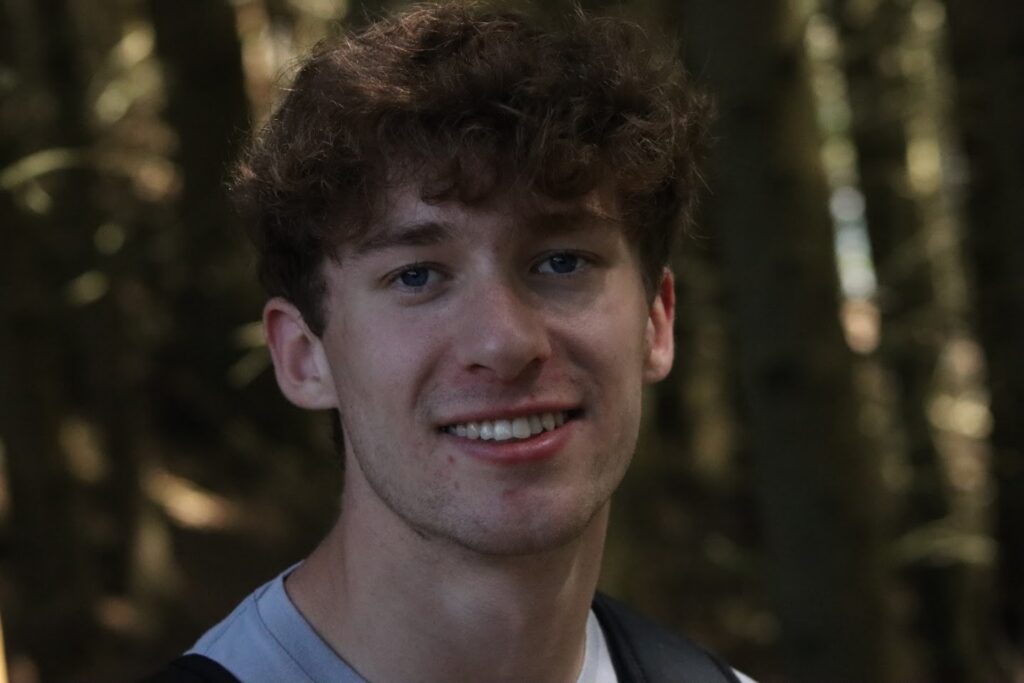
Bio: I’m currently a 3rd year student at the University of Plymouth, studying the MGeol degree (Geology with an integrated masters). I’m from Bolton originally and have always had an interest in geology since I was in primary school, endlessly watching documentaries about volcanoes, earthquakes, the formation of the Earth and just about anything else related! In high school and college, I have been lucky to have been given the option to study geology, which further honed my interest in the subject. Growing up in Bolton, I was always a stone’s throw away from the Lake District, where much of my holidays were spent, with my family climbing the peaks and taking rocks back down. Other interests include my love for being in nature, rock music and guitar!
Going to university opened an entire new world to me. Plymouth’s convenient location next to Dartmoor and Devon’s coastland, helped fuel my interest in the outdoors. Throughout my time in Plymouth, I have had a growing interest in academia, although I never knew which path to go down, I realised I was most engaged in all the various aspects of volcanology. I never thought I would end up getting the chance to have a taste of what this path would be like until I started the COMET internship! I’m now more excited than ever to pursue my interest in Volcanology, wherever it takes me!
Project: The question in my project was as follows: Does crustal heterogeneity affect volcano deformation? We can model the ground deformation (detected using GPS, tiltmeters, InSAR etc.) caused by a magma chamber inflating under the ground (often a precursor to an eruption) to understand where the magma chamber is and how big it is (among other things).
Earth’s crust is complex and so are the magma chambers themselves. Sometimes the simpler analytical models aren’t accurate, so all of these other complexities must be considered. Numerical modelling (in my case using COMSOL Multiphysics), allowed me to explore a range of different things (Topography, complex intrusion geometries, layering, faults in the ground etc.) and how they affect ground deformation.
A large part of the project was spent running experiments that tested this modelling software against analogue model (lab-made) of a balloon inflating into a gelatine mixture. Because we know all of the parameters of the analogue model (strength of the gelatine, the size and depth of the balloon), we can accurately benchmark the numerical model I made on COMSOL against it, allowing us to gain more insight into the validity of numerical modelling in the real world.
Outputs: From the research, I was able to make detailed guides on how to reproduce the numerical models of the gelatine tank experiment, as well as some of the other models I tested.
The results of the experiment showed that the numerical model was able to simulate the balloon expanding and deforming the gelatine, with the ability to look at the stresses on and around the balloon. This provided insight into how the tank size affects the results, with deformation against the sides of the tank occurring if it is too small. The large, cuboid tank mitigated this affect more, making the model a more realistic fit to real life, where the crustal domain can be considered as near infinite.
The overall experience: Going into the internship, I was very uncertain about what it would be like to work in a professional academic environment, but very quickly realised it is a very interconnected place, where people share their skills with others, and everyone seems to help each other! I was able to get an insight into the massive range of different research topics being worked on in Leeds, from flood hazards and earthquakes to volcanology.
The first two weeks I spent learning about the topic of my project with the help from my supervisors, who always seemed to be ready to help when I needed it! As the internship went on, I was allowed to tackle the project with complete freedom on the aspect I was most interested (Numerical modelling using COMSOL), but was given as much guidance as needed to use these new skills to help contribute to the project. I got more and more interested in the project and the research surrounding it! I really felt like I was part of COMET while I was doing the project, and my thoughts, opinions and ideas felt valued at every level, which has since boosted my confidence immensely.
I made meaningful contacts and got the chance to make friends with the other interns there, and we all got on very well, frequently meeting at the weekends or after work!
The whole experience was both eye opening and very humbling, and I feel much more prepared for an academic life after my degree than I could’ve possibly imagined.