
The UK Centre for Observation and Modelling of Earthquakes, Volcanoes and Tectonics (COMET) invites you to the next instalment of our COMET online webinar series.
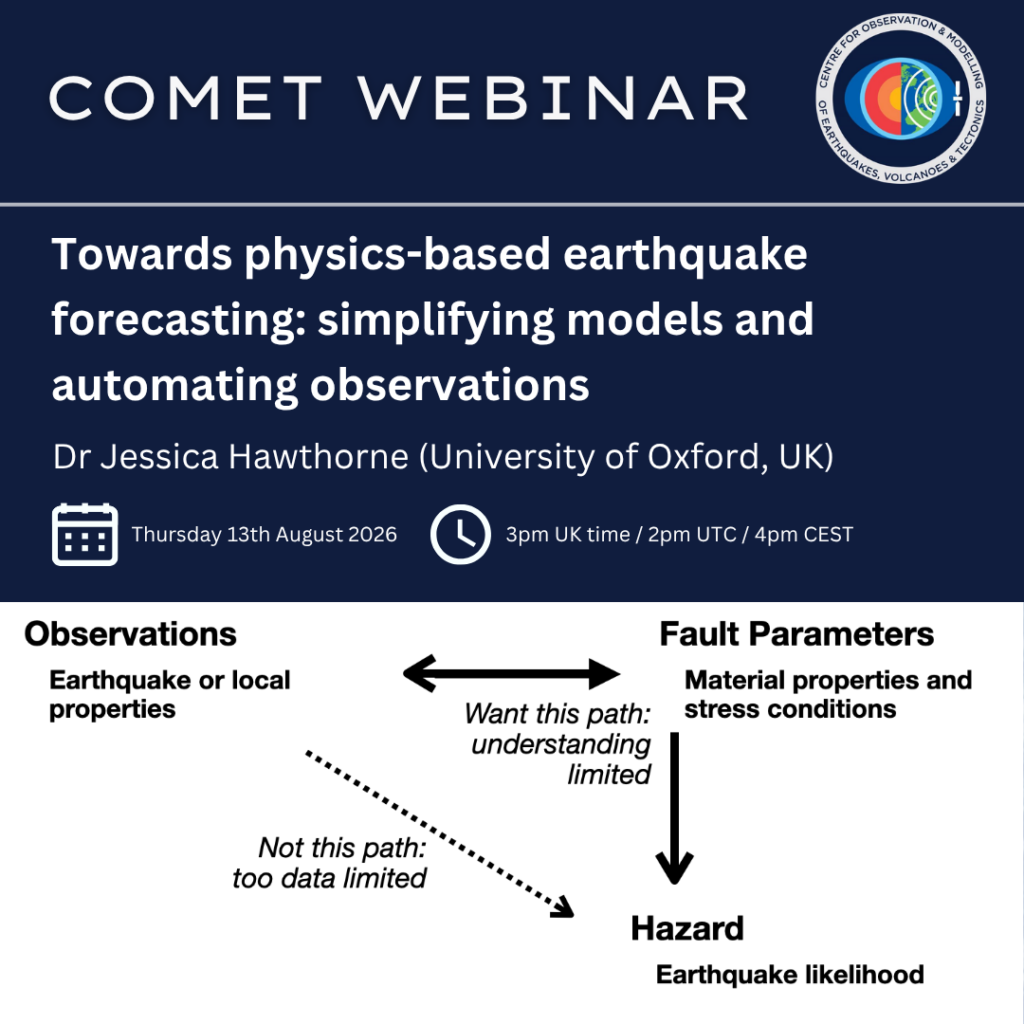
Speaker: Dr Jessica Hawthorne University of Oxford, UK
Title of the talk: Towards physics-based earthquake forecasting: simplifying models and automating observations
Date: Thursday 13th August 2026
Time: 3pm UK time (2pm UTC / 4pm CEST)
(After registering, you will receive a confirmation email containing information on how to join the webinar)
Abstract: Earthquake forecasts are commonly empirical, based primarily on the past distribution of earthquakes. But sometimes we want to forecast earthquakes in “new” scenarios, for instance during an aseismic slip event or induced seismicity. For these scenarios, we require more physics-based earthquake forecasts. In this presentation, we explore some of the observational, modelling, and practical challenges in developing physics-based earthquake forecasting. We focus on developing a simple modelling framework. The rupture simulations are based on energy balance: ruptures propagate as long as the stress intensity at the tip exceeds a critical threshold. Although this approach does not capture the full details of rupture propagation or more complex physics such as off-fault deformation, it does capture first-order rupture physics and allows many ruptures to be simulated in complex stress fields. To explore earthquake potential across a range of physical environments, we simulate ruptures in stress fields with different mean initial stresses, then perturb those fields. Ruptures nucleate from the point of maximum stress, and we track the frequency, magnitude, and stress drop of the resulting events. Restricting ruptures to one-dimensional geometries allows tens of thousands of simulations in a few hours on a desktop computer. These simulations define a mapping between fault initial conditions and resulting seismicity, which we represent with a neural network. We also explore another challenge in physics-based forecasting: making enough observations to constrain and test such models. We therefore also work on developing tools to observe more features of earthquakes, including their beginnings and their spatial extents. We show how these features can be systematically and quickly measured and how they may be used both to test physical models of earthquake rupture and to improve forecasting.
The 2024/2025 COMET Annual Report is now available to view online
Click here to read previous annual reports, from 2014-present.