A new paper published in Geophysical Research Letters by Tom Pering and Andrew McGonigle has combined fluid dynamical modelling of gas flow in conduits with high time resolution measurements of volcanic gas discharge for the first time, revealing new insights into the dynamics of Stromboli volcano.
Their work is based on a recently developed approach using ultraviolet cameras which enable measurements of volcanic gas emission rates with unprecedented time resolution – around 1 Hz – such that gas release patterns associated with rapid explosive and non-explosive basaltic processes, can be resolved for the first time.
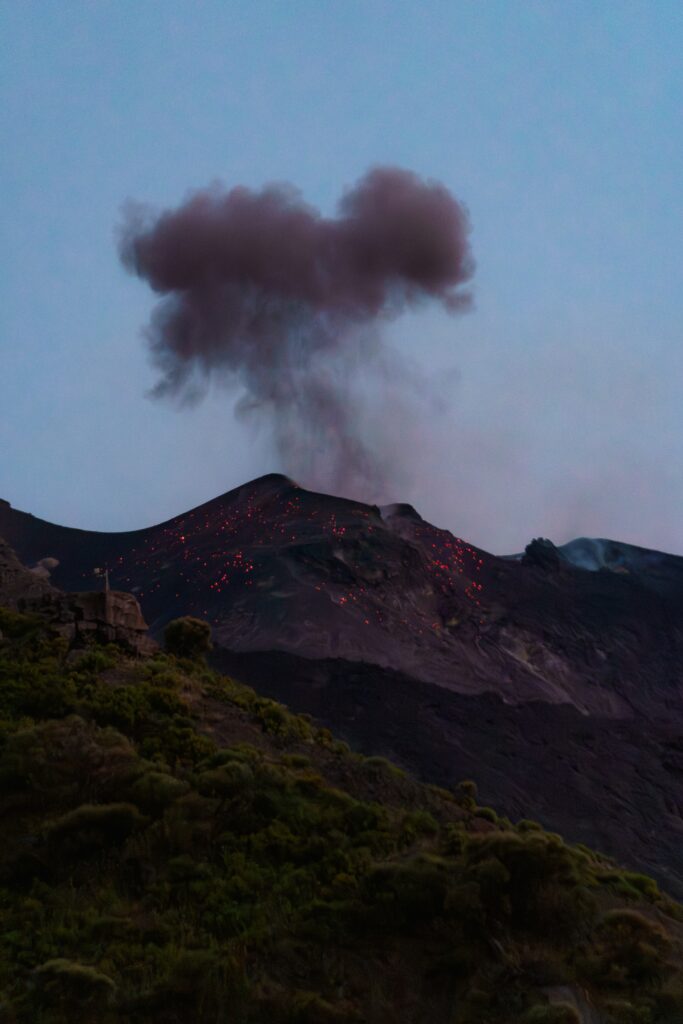
Data were captured on Stromboli, where an intriguing coda of lifetime on the order of 10s of seconds was identified following each explosion. Computational models were also developed to simulate the upward flow of conduit filling, so called “Taylor bubbles”, which are believed to be responsible for explosions on Stromboli when they burst at the surface.
The numerical models reveal the fissioning of smaller bubbles from the Taylor bubble bases to generate a train of “daughter bubbles”, thought to be responsible for generating the post-explosive coda upon arrival at the surface.
This process could play a primary yet hitherto unconsidered role in driving the dynamics of strombolian volcanism, both on Stromboli and other targets worldwide, with significant implications for the magnitude of resulting eruptions.
Combining models with field observations in this way shows considerable promise for improving our understanding of how gases drive volcanic activity.
The full reference is: T.D Pering, A. J. S McGonigle, M. R James, G. Tamburello, A. Aiuppa, D. Delle Donne, M. Ripepe Conduit dynamics and post-explosion degassing on Stromboli: a combined UV camera and numerical modelling treatment, Geophysical Research Letters 2016 DOI: 10.1002/2016GL069001