Congratulations to COMET scientist Professor Andy Hooper, who has been awarded the American Geophysical Union (AGU) James B. Macelwane Medal in recognition of his contributions to the geophysical sciences.
Established in 1961, the medal is given to outstanding early career scientists who have shown depth, breadth, impact, creativity, and novelty in their research.
Professor Hooper, who is also Co-Director of the Institute of Geophysics and Tectonics at University of Leeds, pioneered the development of new software (StaMPS) to extract ground displacements from time series of synthetic aperture radar (SAR) acquisitions. StaMPS is now used widely across the Earth Observation community.
He also discovered a new link between ice cap retreat and volcanism via geodetic monitoring from space and subsequent modelling of the 2010 Icelandic volcanic eruptions, and played a significant role in the €6m FUTUREVOLC project, leading the long-term deformation effort to integrate space and ground based observations for improved monitoring and evaluation of volcanic hazards.
Alongside other COMET researchers, he was part of a team contributing to the international scientific response to the earthquake which devastated Nepal in April 2015.
Eruption column and lava flow at Bárdarbunga, 22 September 2014. Credit: Thórdís Högnadóttir
Professor Hooper will be presented with the award at the 2016 AGU Fall Meeting, where he will also be giving a talk at the Union Session focusing on the new generation of scientists, where he will also be conferred an AGU fellow.
Congratulations Andy from all your colleagues at COMET.
COMET scientists have helped to shed new light on how volcanoes collapse during major eruptions, in new research published in Science.
The study, led by the University of Iceland, investigated a recent collapse at Bárdarbunga Volcano, Iceland, during the biggest volcanic eruption in Europe since the huge event at Laki in 1784.
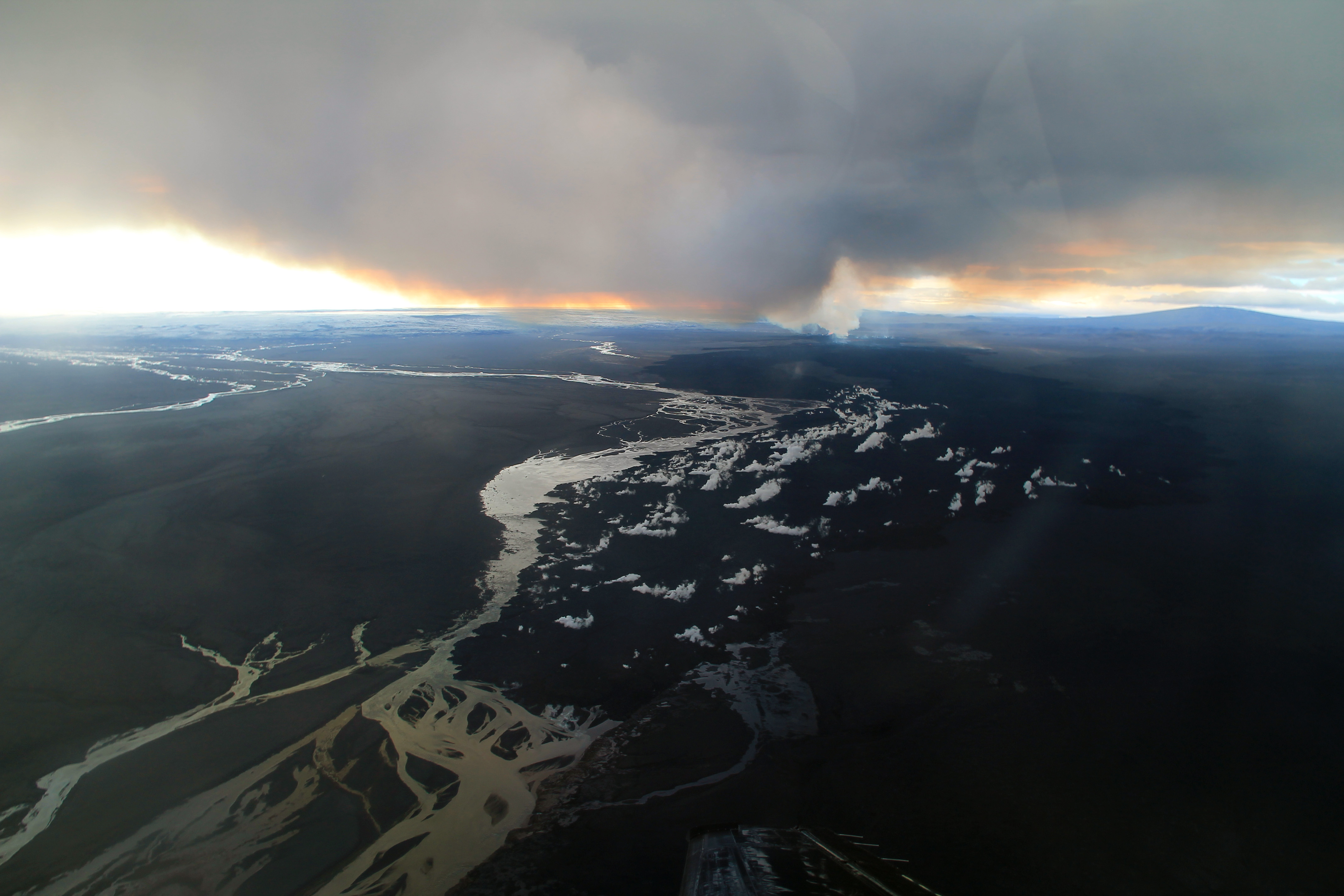
Eruption column and lava flow from the air on 22 September 2014. Credit: Thórdís Högnadóttir
The largest eruptions on Earth are commonly associated with collapse of the roof of a volcano into a magma chamber below. As they are infrequent, however – only five caldera collapses were recorded during the twentieth century – the processes involved are poorly understood.
The Bárdarbunga eruption, which lasted from August 2014 until February 2015, produced 1.5 km3 of basaltic lava. In the course of the eruption, the top of the volcano caldera gradually sagged downwards, leaving an elongated bowl shaped depression over 13 km long and up to 65 m deep.
Bárdarbunga from the north, showing the main subsidence bowl within the caldera. Credit: Magnús T. Gudmundsson
The total volume of the subsidence was 1.8 km3 – similar to the total volume of lava erupted and injected into the crust , implying a strong link between the two.
COMET scientist Marco Bagnardi said: “We saw the events at Bárdarbunga as an opportunity to better understand caldera collapse, and used multiple techniques to investigate.”
COMET researchers used radar data from satellites to measure ground deformation at Bárdarbunga’s caldera over a number of 24 hour periods. As the topography continually changed, these data revealed movement of faults that reached to within a kilometre or so of the surface.
Combined with other techniques, including airborne altimetry, high precision GPS, seismology, radio-echo soundings, and ice flow modelling, the results were used to create a detailed picture and timeline of how the caldera was collapsing and why.
From 16 August 2014 – before the eruption began – magma had been migrating out of a chamber 12 km below the ground, forming a fracture in the Earth’s crust. Continued monitoring during the event showed that the magma was moving sideways from the volcano, beneath the surface, before finally erupting at Holuhraun, 47 km to the northeast, two weeks later.
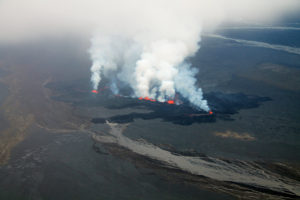
The eruption in Holuhraun on its fourth day (3 September 2014). Credit: Thórdís Högnadóttir
Further analysis showed that a few days after the initial migration, the outflow of magma activated faults around the edge of the caldera leading to a series of earthquakes, which marked the beginning of the caldera collapse. The collapsing roof then acted like a piston forcing even more magma out of the chamber below, which in turn led to further collapse.
COMET scientist Professor Andy Hooper explained: “Through modelling many different data sets, we were able to show that the caldera collapse was caused by magma leaving the reservoir, and this in turn squeezed more magma out of the reservoir, forming a positive feedback. This mechanism led to much more magma being erupted than would otherwise have been the case, which explains how eruptions on an even larger scale can occur.”
Overall, between 12 and 20% of the magma had left the magma chamber when the caldera collapse began.
Summarising the research, Prof Hooper added: “This work has given us real insight into caldera collapse, not only at Bárdarbunga but also at even larger eruptions. What’s particularly interesting is how the collapse of the magma reservoir and the flow out of it clearly amplify each other.”
The paper, available now in Science, is Gudmundsson et al. (2016) Gradual caldera collapse at Bárdarbunga volcano, Iceland, regulated by lateral magma outflow, doi:10.1126/science.aaf8988
Manage Consent
To provide the best experiences, we use technologies like cookies to store and/or access device information. Consenting to these technologies will allow us to process data such as browsing behavior or unique IDs on this site. Not consenting or withdrawing consent, may adversely affect certain features and functions.
Functional
Always active
The technical storage or access is strictly necessary for the legitimate purpose of enabling the use of a specific service explicitly requested by the subscriber or user, or for the sole purpose of carrying out the transmission of a communication over an electronic communications network.
Preferences
The technical storage or access is necessary for the legitimate purpose of storing preferences that are not requested by the subscriber or user.
Statistics
The technical storage or access that is used exclusively for statistical purposes.The technical storage or access that is used exclusively for anonymous statistical purposes. Without a subpoena, voluntary compliance on the part of your Internet Service Provider, or additional records from a third party, information stored or retrieved for this purpose alone cannot usually be used to identify you.
Marketing
The technical storage or access is required to create user profiles to send advertising, or to track the user on a website or across several websites for similar marketing purposes.