COMET Scientist Professor David Pyle (University of Oxford) is the recipient of the 2024 Murchison Medal, awarded by the Geological Society of London for his considerable contributions to the field of volcanology.
The Murchison Medal is awarded to geologists who have contributed significantly to ‘hard’ rock studies. David is an internationally recognised volcanologist who has made outstanding contributions to understanding volcanic deposits and processes, using pioneering methods to characterise and classify tephra fall deposits and infer erupted volumes.
The Geological Society will host a formal awards ceremony on 12 June with more details of the day to be shared via its magazine Geoscientist, website and social media channels.
Congratulations David from all of your colleagues at COMET!
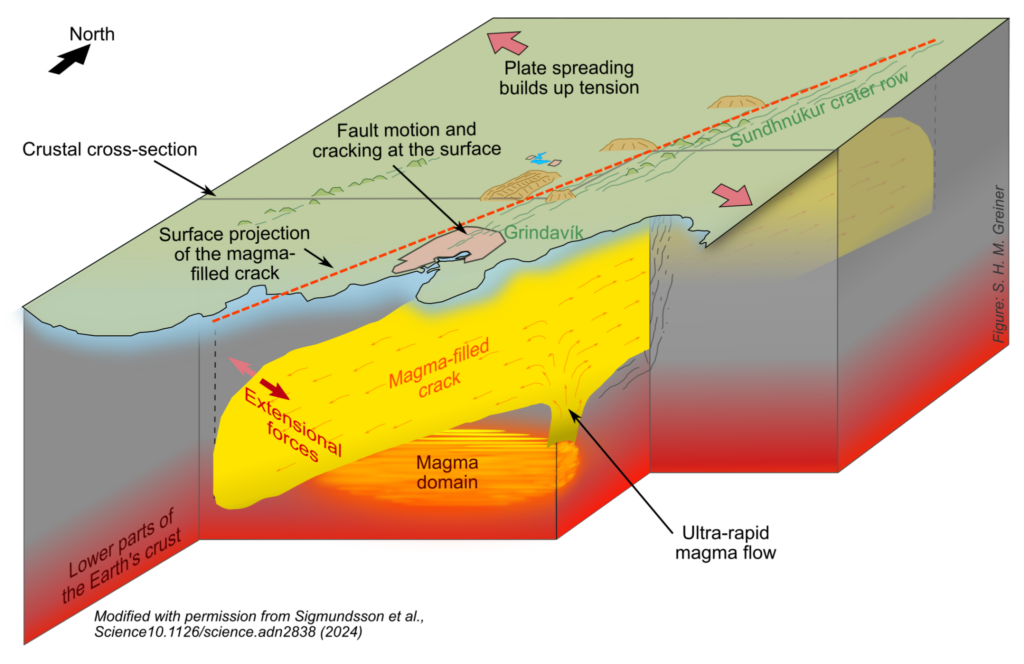
In November 2023, a state of emergency was suddenly declared in a fishing town in Iceland, Grindavík, and all residents were rapidly evacuated. In the space of around 6 hours, escalating seismic activity was felt: large cracks and fault movements occurred at the earth’s surface, and homes, businesses and infrastructure were destroyed.
This devastation was caused by huge amounts of magma moving at an unprecedented speed below the surface, which rushed into a crack that opened up below the town. The intrusion that formed was approximately 15-kilometres-long and extended around 1-5 km deep, with widening of up to 8 meters.
The processes and timescales behind the formation of major cracks, or “dikes”, aren’t currently fully understood but the international team of researchers behind a paper published in Science today have revealed new findings that shed some light on how these hazardous events occur.
Using detailed satellite observations alongside seismic measurements and physical modelling, the team of investigators led by University of Iceland and the Icelandic Meteorological Office, found that the magma flow rate under the surface of the earth reached an ultra-rapid and previously unrecorded speed of 7400 cubic meters per second. The study also shows that huge amounts of magma can be forced into cracks due to fracturing in the earth and tectonic stress, without much pressure coming from underlying magma source that feeds it. These findings demonstrate a significant hazard potential for this volcanic system and others with similar features, which can result in large-volume magmatic eruptions on the surface.
COMET Scientist, Professor Andy Hooper, was a key member of the team of investigators:
“Nothing like these rates of magma flow have ever been measured before. Luckily, the magma did not make it to the surface at that time, but this helps us understand how magma-filled cracks that are tens of kilometres long may have formed in the past.”
The events in November were the beginning of the activity in the affected area around Grindavík. Smaller magma intrusions occurred in December 2023 and January 2024, which unfortunately culminated in large eruptions and further devastation in the town, and a new, ongoing eruption started this morning (February 8th 2024).
To provide the best experiences, we use technologies like cookies to store and/or access device information. Consenting to these technologies will allow us to process data such as browsing behavior or unique IDs on this site. Not consenting or withdrawing consent, may adversely affect certain features and functions.
Functional
Always active
The technical storage or access is strictly necessary for the legitimate purpose of enabling the use of a specific service explicitly requested by the subscriber or user, or for the sole purpose of carrying out the transmission of a communication over an electronic communications network.
Preferences
The technical storage or access is necessary for the legitimate purpose of storing preferences that are not requested by the subscriber or user.
Statistics
The technical storage or access that is used exclusively for statistical purposes.The technical storage or access that is used exclusively for anonymous statistical purposes. Without a subpoena, voluntary compliance on the part of your Internet Service Provider, or additional records from a third party, information stored or retrieved for this purpose alone cannot usually be used to identify you.
Marketing
The technical storage or access is required to create user profiles to send advertising, or to track the user on a website or across several websites for similar marketing purposes.