Earth Observation satellites can now detect extremely small changes on the Earth’s surface. By using satellite data, alongside ground-based and other observations, COMET monitors earthquakes and volcanoes across the globe. Regularly gathering and analysing this information helps decisionmakers around the world to reduce the impact of natural hazards, from hazard preparedness to event response.
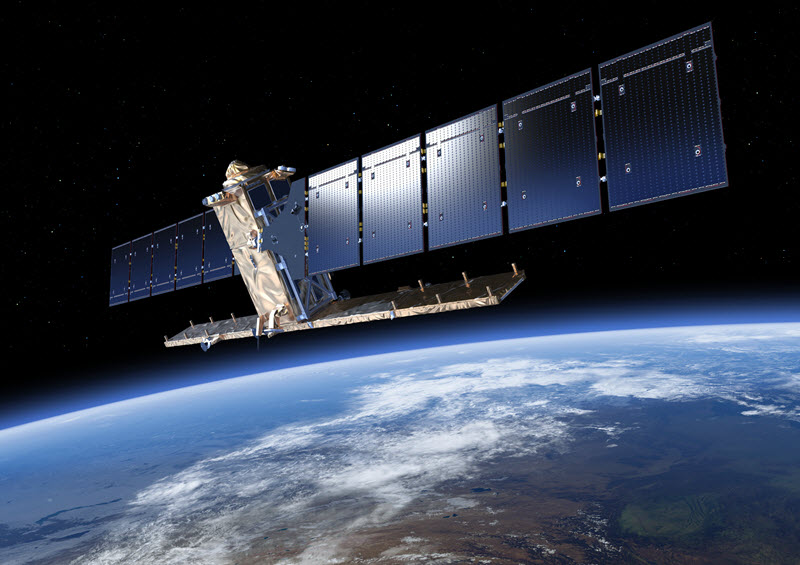
Satellites such as the European Space Agency’s Sentinel-1 help us to understand how the ground deforms around earthquake centres, faults and volcanoes. They can give very precise measurements of ground motion that we can combine with other techniques to create geophysical models of what is happening beneath the Earth’s surface.
Sentinel-1 Satellite Credit: European Space Agency
High-resolution imagery and topographic data can also help us to identify seismic and volcanic hazards, and we can use spectroscopy to quantify gas and ash emissions from volcanoes.
All of these techniques provide vital information on the processes underpinning these geohazards.
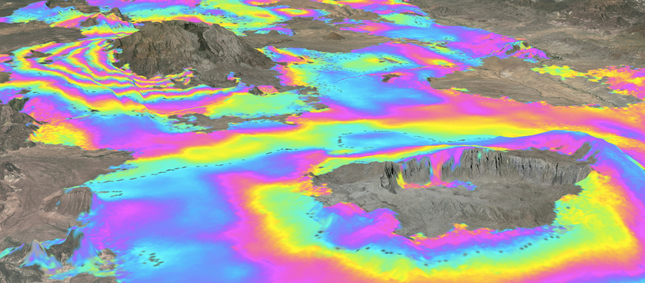
COMET scientists are at the forefront of international efforts to monitor active volcanism by combining satellite observations of deformation (changes in the size or shape of a volcano or the surrounding areas), topographic change (shifts in a landscape’s surface or physical features), and volcanic gases with ground-based observations.
Interferogram constructed from satellite data, showing the lateral extent of volcanic interaction. Credit: Juliet Biggs (University of Bristol)
We have conducted a series of multiscale, multi-observable studies of recent eruptions, and COMET scientists have been key international partners during the response to major volcanic crises, including major events at Fentale (Ethiopia), Fagradalsfjall (Iceland), La Soufriere (St Vincent) and La Palma (Spain).
Through the BGS we provide weekly briefs to the UK government on volcanic activity globally through International Forward Look and the EU through ARISTOTLE, with the ability to increase reporting frequency during crises.
We have been developing interactive tools targeted at volcano observatories, as well as exploiting new advances in machine learning to flag volcanic deformation events. We have also developed new methods to produce near real-time SO2 flux and plume height time series data during explosive eruptions and passive degassing.
By combining satellite observations with detailed understanding of physical processes and evolving understanding of magmatic conditions under the ground, COMET scientists are helping to understand subsurface processes and build new models of magmatic processes.
If we wish to stop eruptions from becoming disasters we need to (i) make rapid observations and quickly identify potential precursory signals, (ii) interpret these using reliable modelling frameworks and (iii) work in partnership with local volcano observatories and volcanic ash advisory centres to enable them to make improved critical decisions.
Since its inception, COMET has always been at the forefront of combining satellite, seismological, and fieldwork observations with numerical models to address major questions regarding earthquakes and tectonics.
We have an established track record of producing scientific advances as part of multidisciplinary studies that break new ground where single-topic projects fail to advance. For examples, see our projects and collaborations.
Many of our scientific advances are built upon the results of our underpinning National Capability science programme in EO Data and Services. A recent COMET study, for example, used InSAR to image the rate of ground movement, and strain accumulation on major faults, across the entirety of the north-eastern Tibetan Plateau.
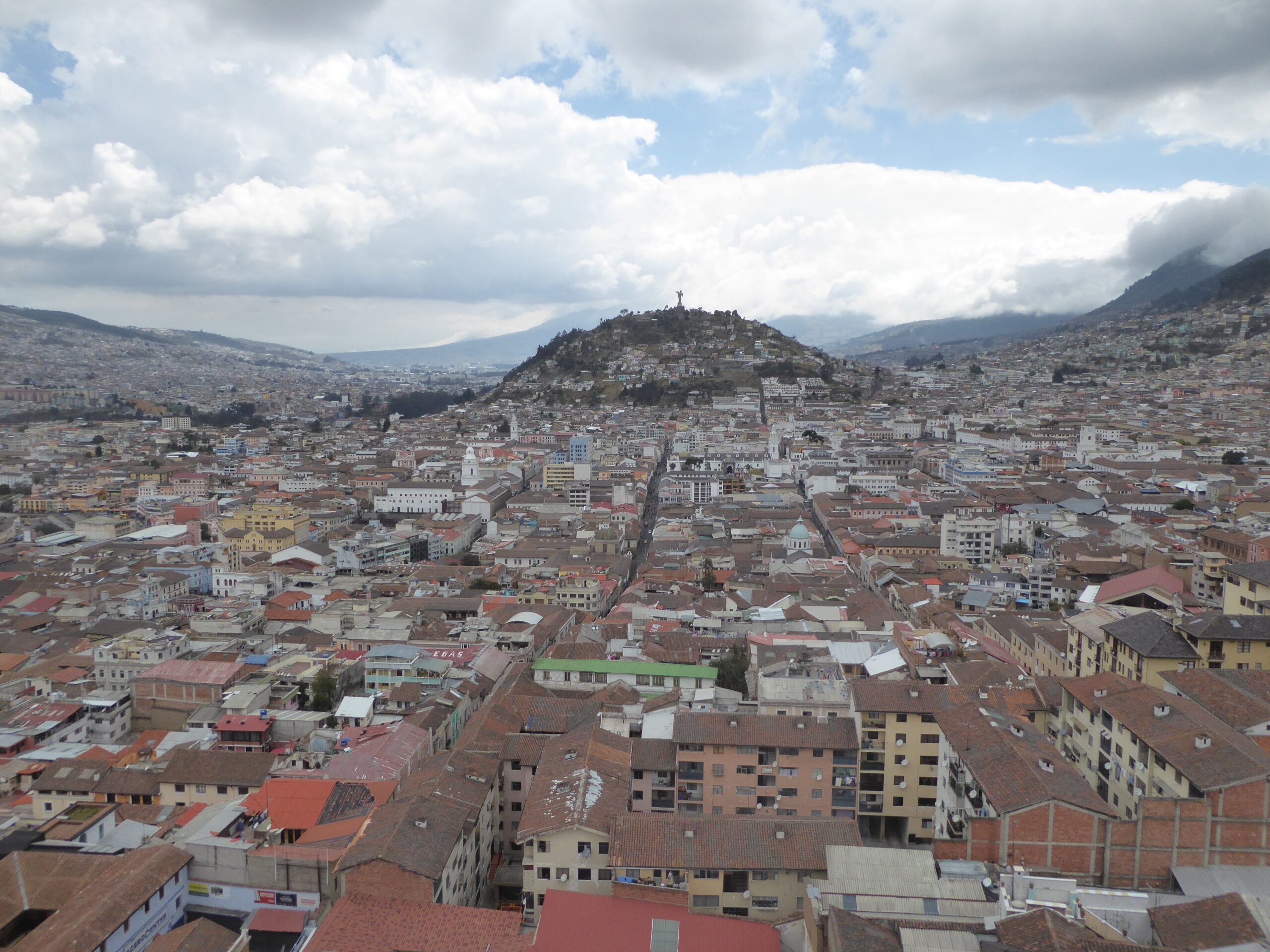
Quito, Ecuador. Credit: Scott Watson (University of Leeds)
It is our commitment to advancing knowledge through high-impact academic research that places us in the expert and well-knowledgeable position to be able to provide expert advice regarding earthquakes and tectonics.
To provide the best experiences, we use technologies like cookies to store and/or access device information. Consenting to these technologies will allow us to process data such as browsing behavior or unique IDs on this site. Not consenting or withdrawing consent, may adversely affect certain features and functions.
Functional
Always active
The technical storage or access is strictly necessary for the legitimate purpose of enabling the use of a specific service explicitly requested by the subscriber or user, or for the sole purpose of carrying out the transmission of a communication over an electronic communications network.
Preferences
The technical storage or access is necessary for the legitimate purpose of storing preferences that are not requested by the subscriber or user.
Statistics
The technical storage or access that is used exclusively for statistical purposes.The technical storage or access that is used exclusively for anonymous statistical purposes. Without a subpoena, voluntary compliance on the part of your Internet Service Provider, or additional records from a third party, information stored or retrieved for this purpose alone cannot usually be used to identify you.
Marketing
The technical storage or access is required to create user profiles to send advertising, or to track the user on a website or across several websites for similar marketing purposes.