Professor Tamsin Mather elected Fellow of the Royal Society

Professor Tamsin Mather elected Fellow of the Royal Society

Professor Tamsin Mather, COMET Scientist and Professor of Earth Sciences at the University of Oxford, is amongst the distinguished group of scientists who have been elected Fellows of the Royal Society this year. This highly prestigious title is awarded to scientists who have made an exceptional and important contribution to science.

Professor Mather’s work is certainly deserving of this honour, as she has produced significant advances in the understanding of volcanoes and volcanic behaviour. Working across different areas of expertise, her research includes the study of atmospheric chemistry of volcanic plumes, magma movement and the flow of fluids under and through volcanic areas, volcanic deformation, and past eruptive behaviour. The drive behind these varied investigations is to understand volcanoes as a natural hazard, but also as key resources (e.g., geothermal power) and as an important planetary process that contributes to maintaining the environment and driving change. Professor Mather’s contributions to the field include the discovery that volcanic vents perform nitrogen fixation, which may have been crucial during the early evolution of life on Earth, and the potential of the element mercury as a tracer for past large-scale volcanism, with widespread environmental impacts.

The many honours bestowed on Professor Mather for her important contributions to the field include the Royal Society Rosalind Franklin Award (2018) and Geochemistry Fellowship of the Geochemical Society and the European Association of Geochemistry (2022), which is bestowed upon outstanding scientists who have made a major, long-term contribution to the field of geochemistry. She is also a Fellow of The Alan Turing Institute for Data Science and AI (2021) and was elected to Academia Europaea in 2021.

Professor Mather’s contributions to science extend beyond her research, including science communication, advocacy, and working to increase diversity and inclusion in the sciences. If you want to hear or read more about her work and experiences, her book, Adventures in Volcanoland, was published in April 2024 and combines exciting scientific discoveries with personal stories, or you could listen to ‘Supervolcanoes’ on the BBC’s Infinite Monkey Cage podcast.

Sir Adrian Smith, President of the Royal Society, commented on the list of awards this year:

“I am pleased to welcome such an outstanding group into the Fellowship of the Royal Society. This new cohort have already made significant contributions to our understanding of the world around us and continue to push the boundaries of possibility in academic research and industry. From visualising the sharp rise in global temperatures since the industrial revolution to leading the response to the Covid-19 pandemic, their diverse range of expertise is furthering human understanding and helping to address some of our greatest challenges. It is an honour to have them join the Fellowship.”

COMET would like to offer warm congratulations to Professor Mather on receiving her Fellowship of the Royal Society!
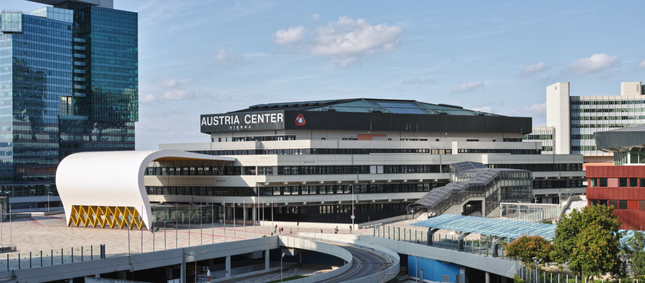
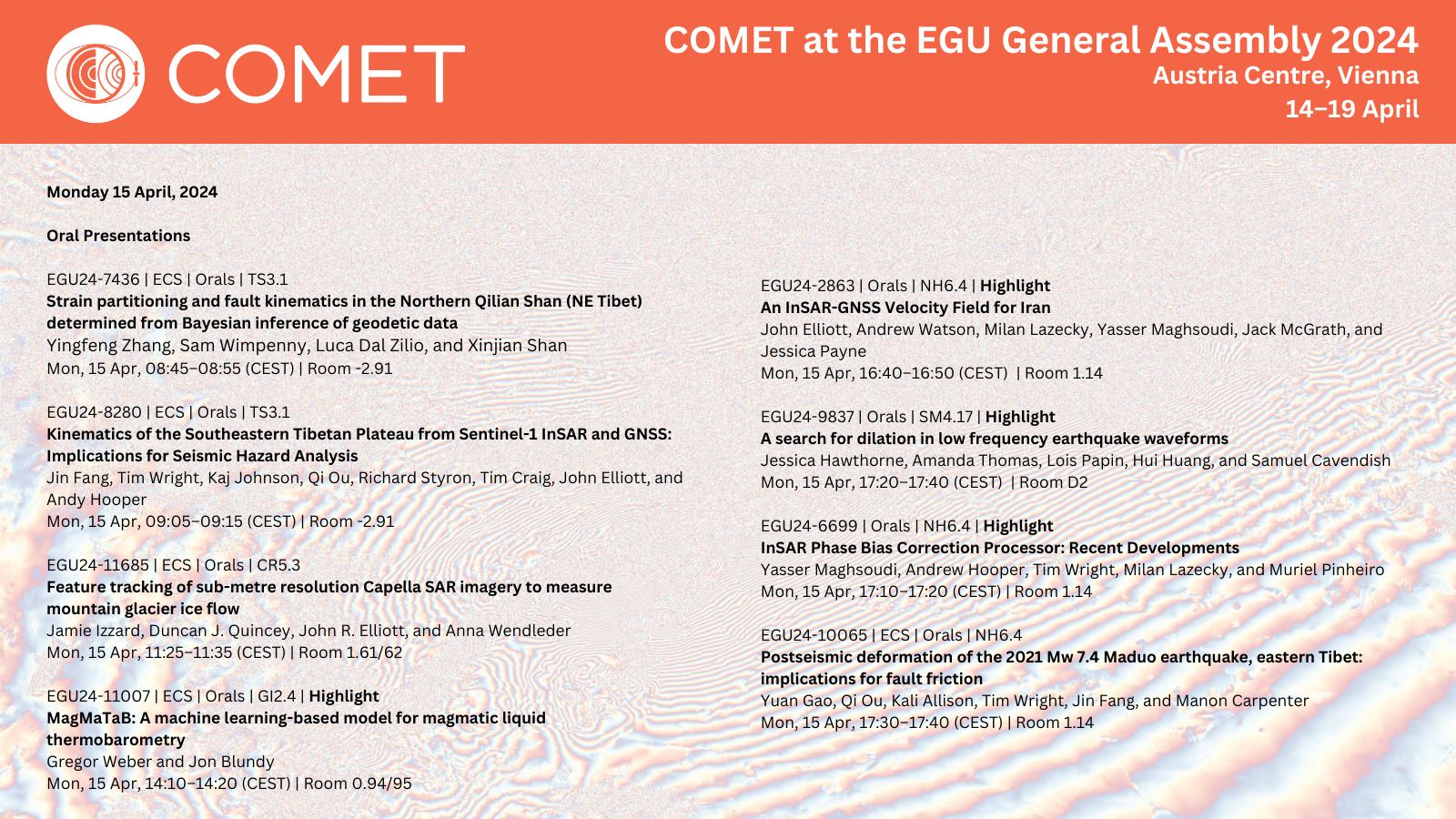
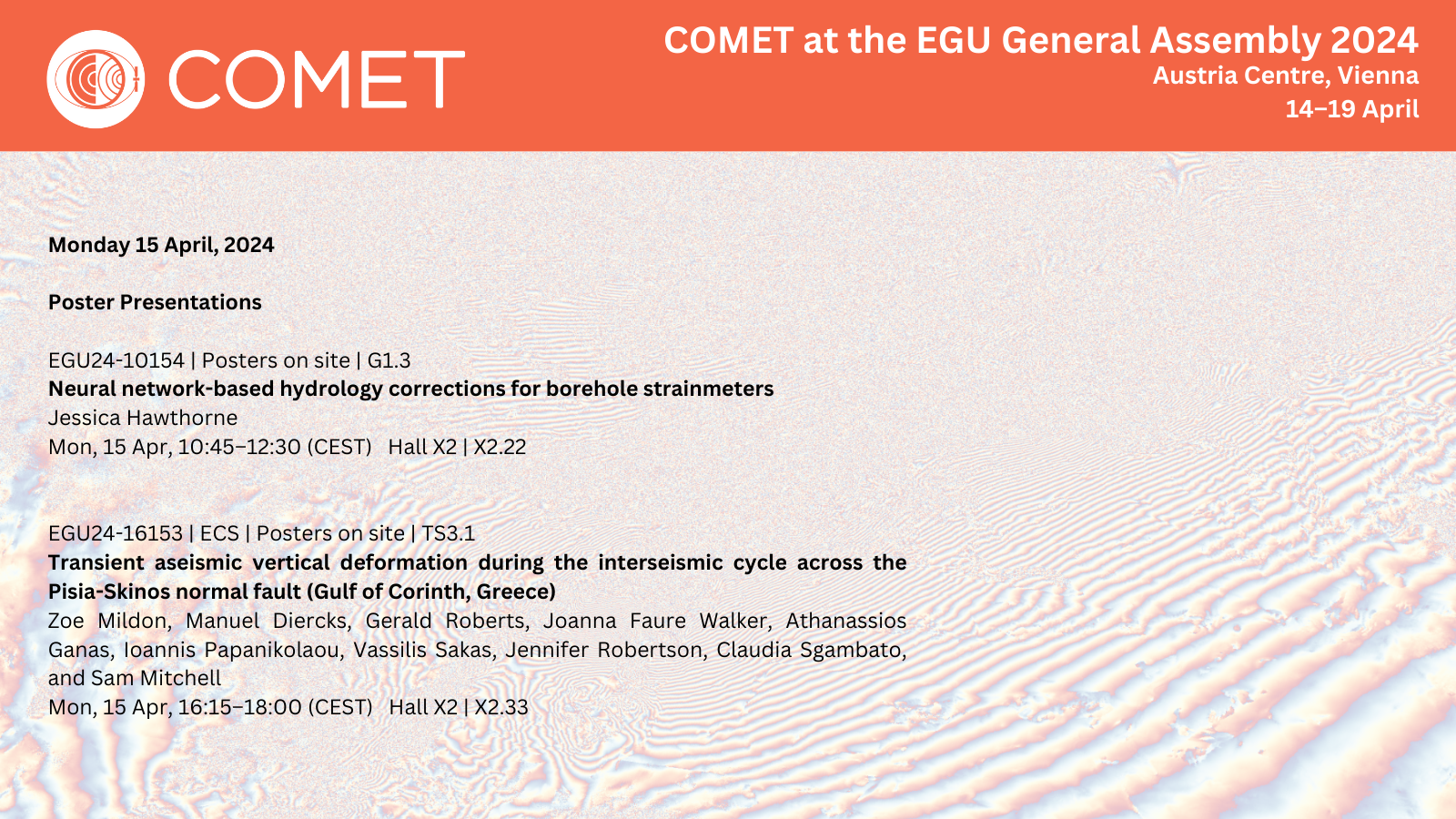
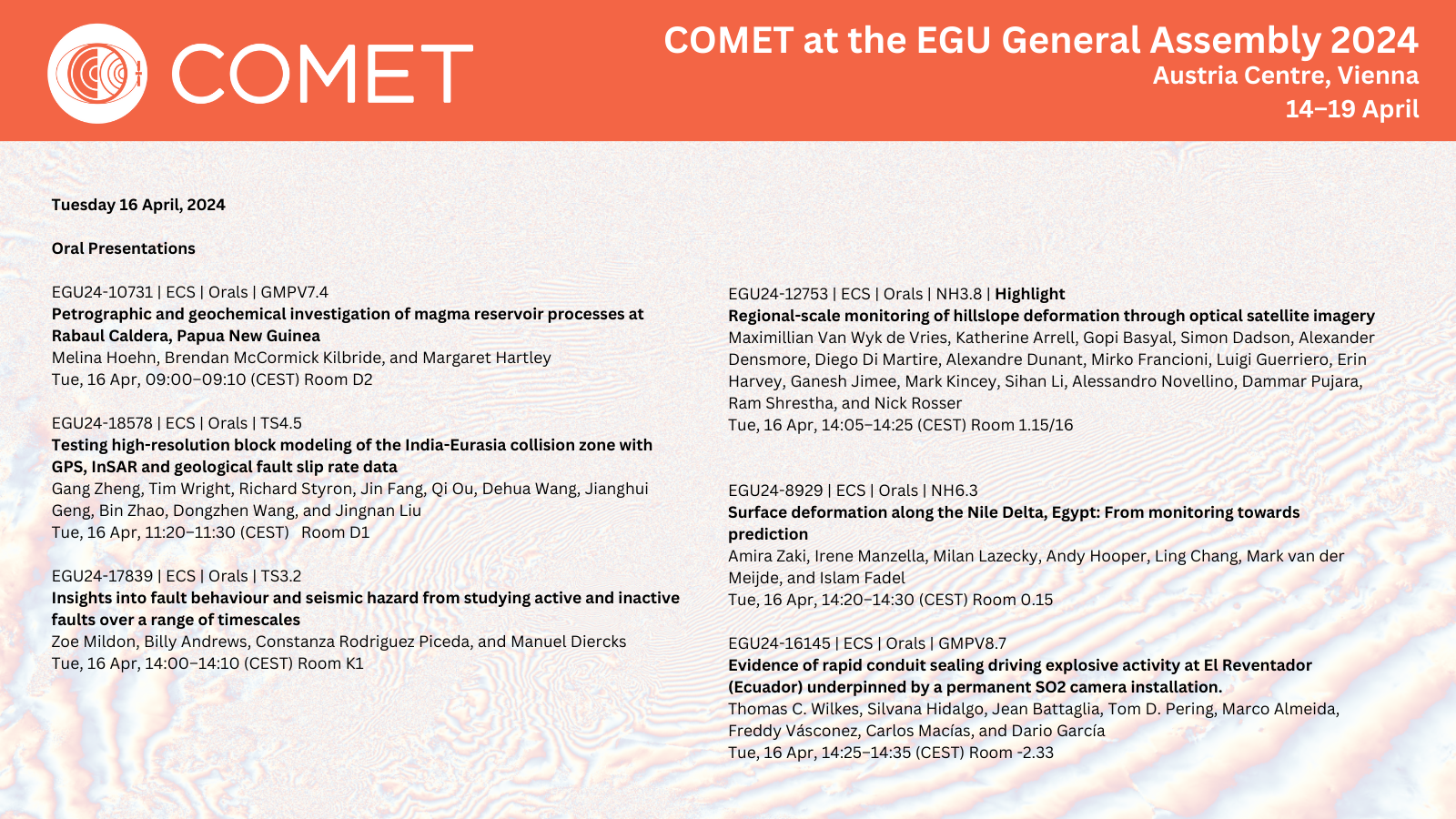
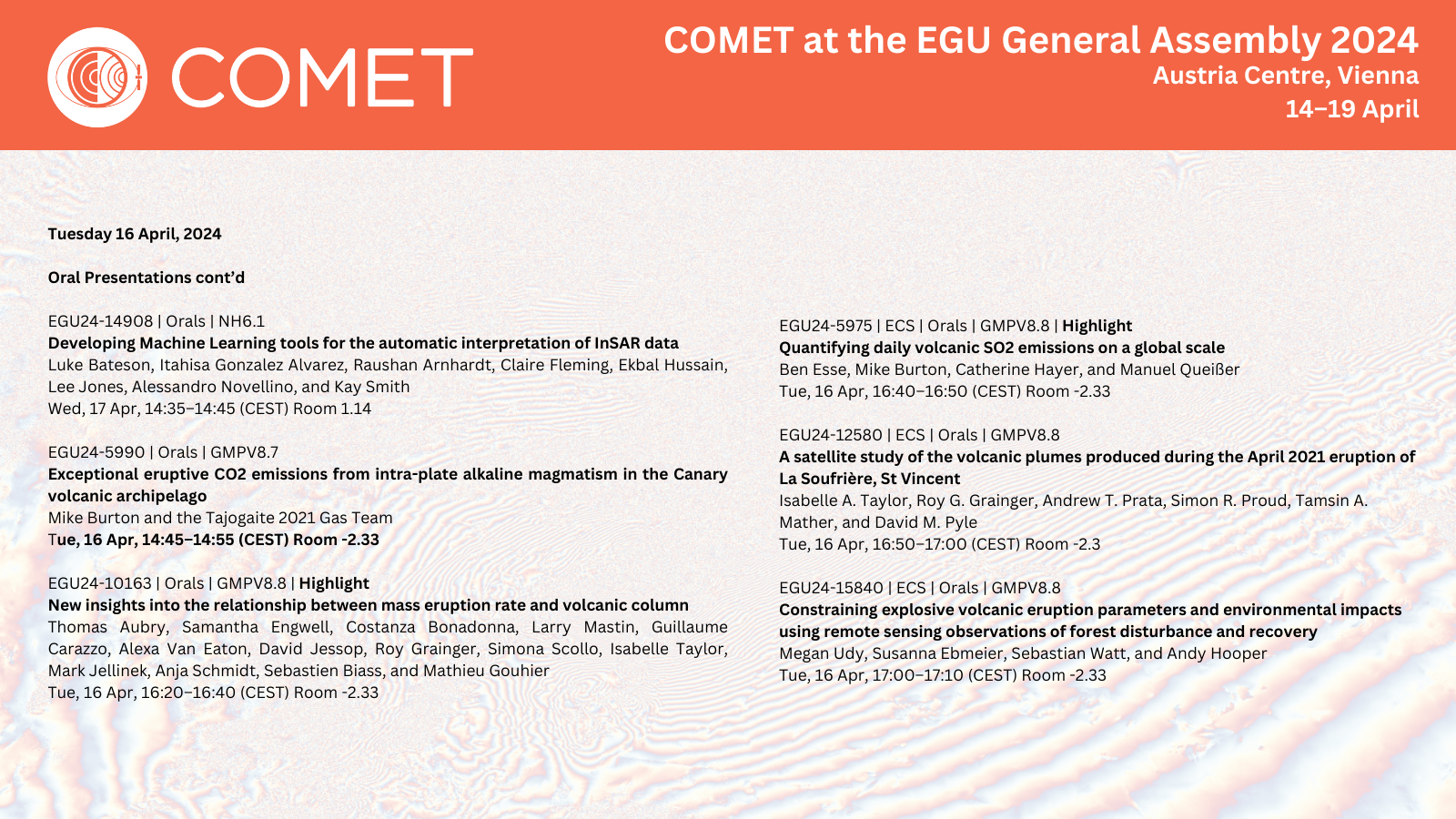
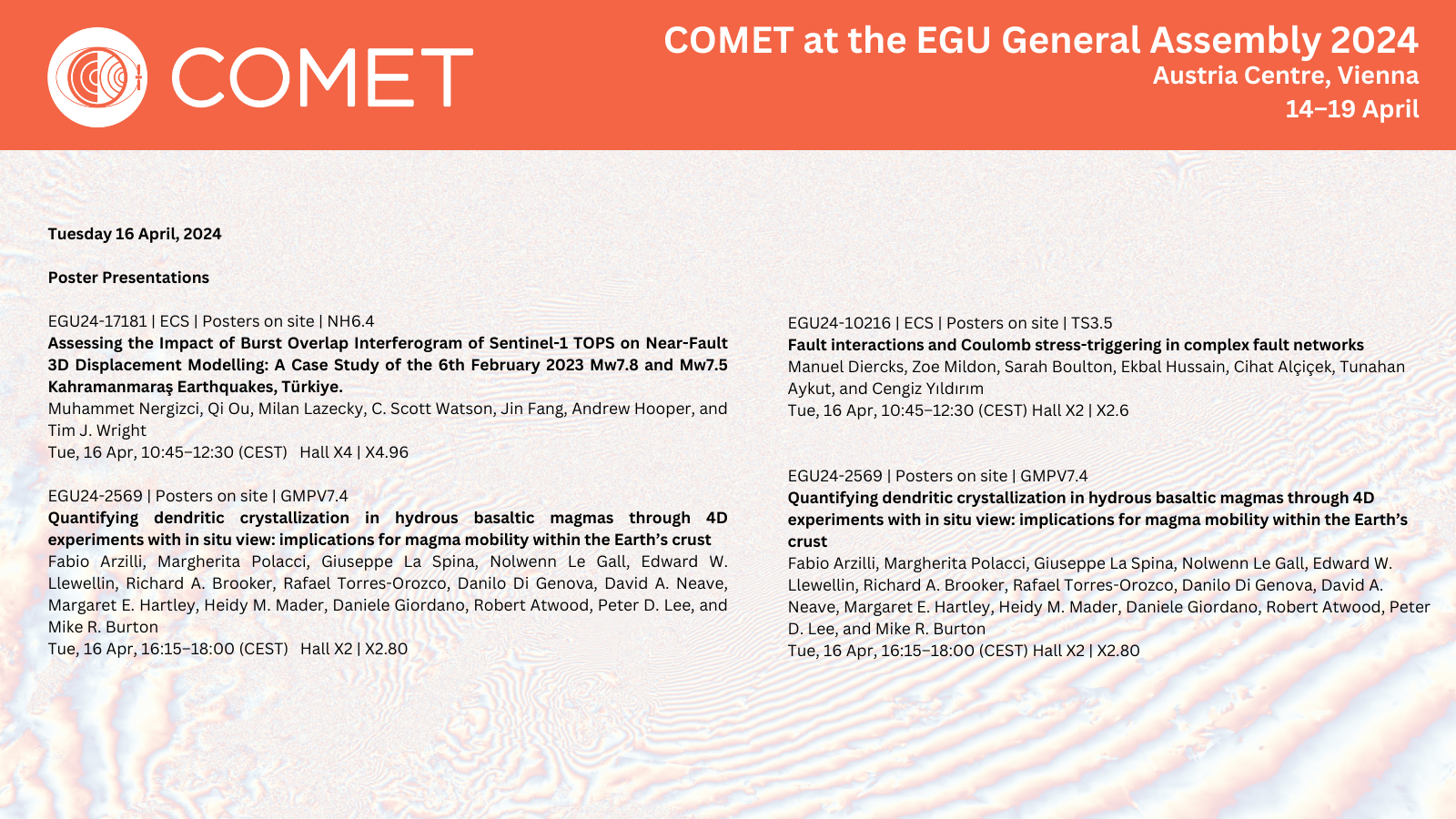
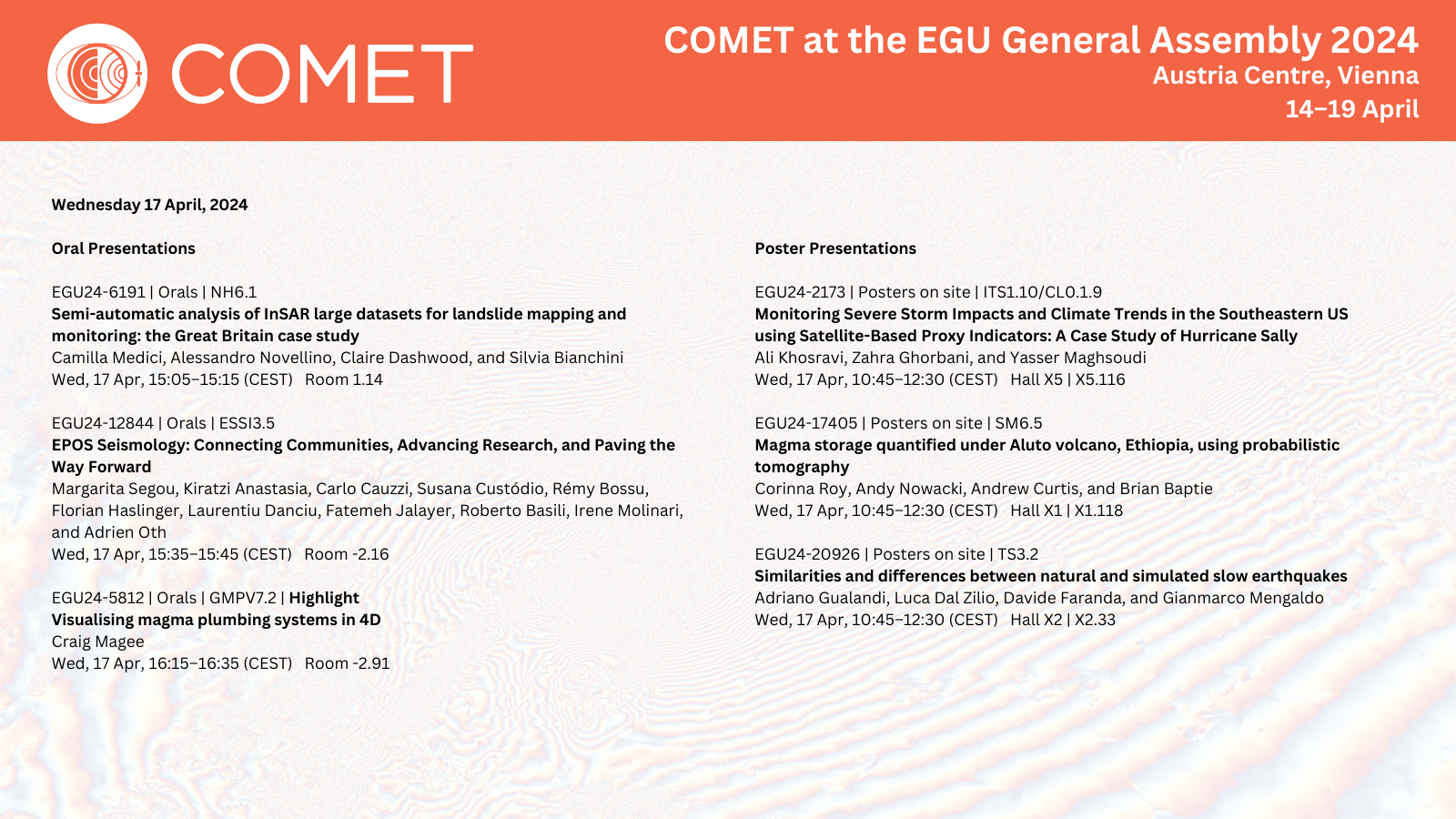
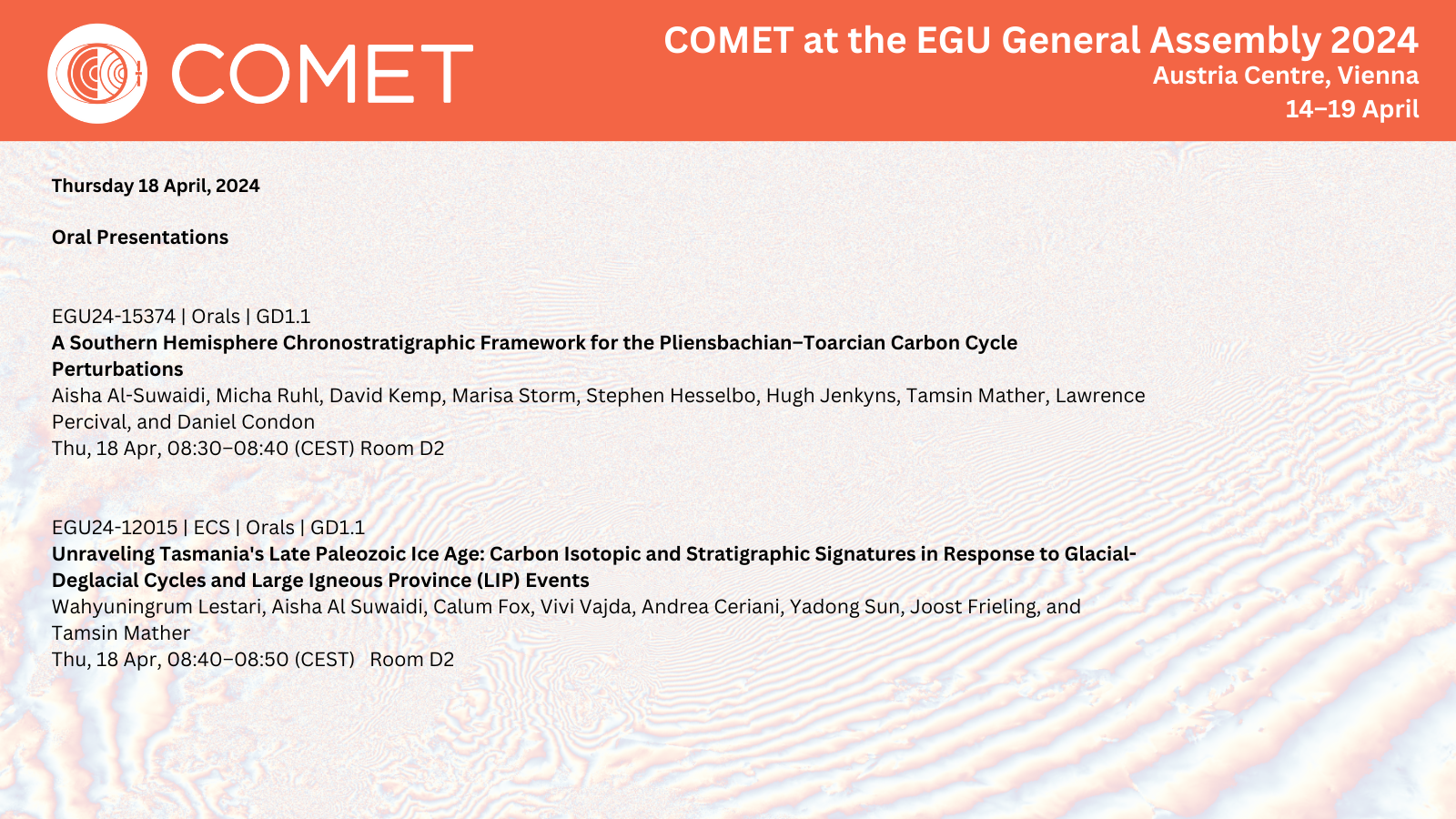
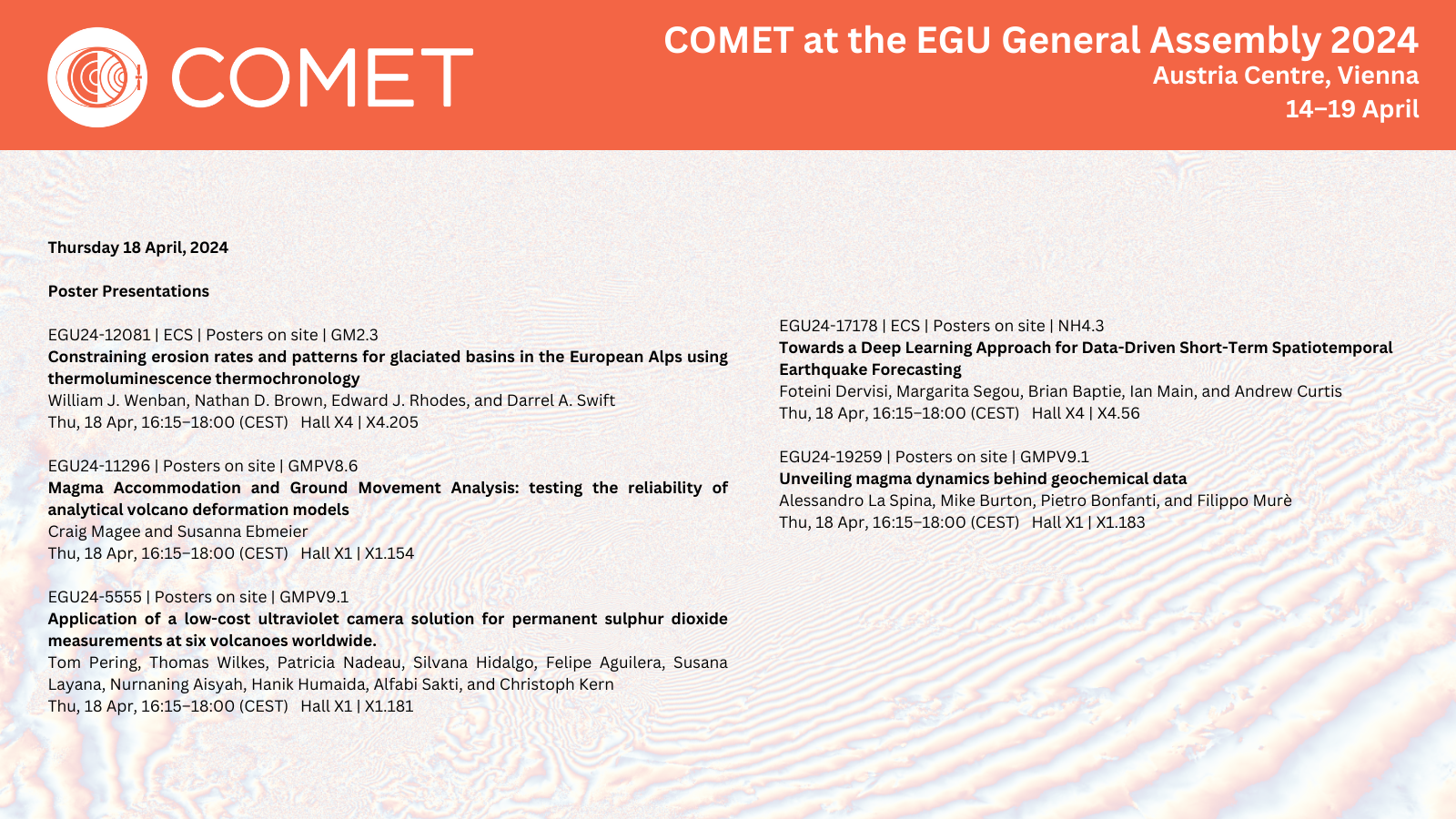
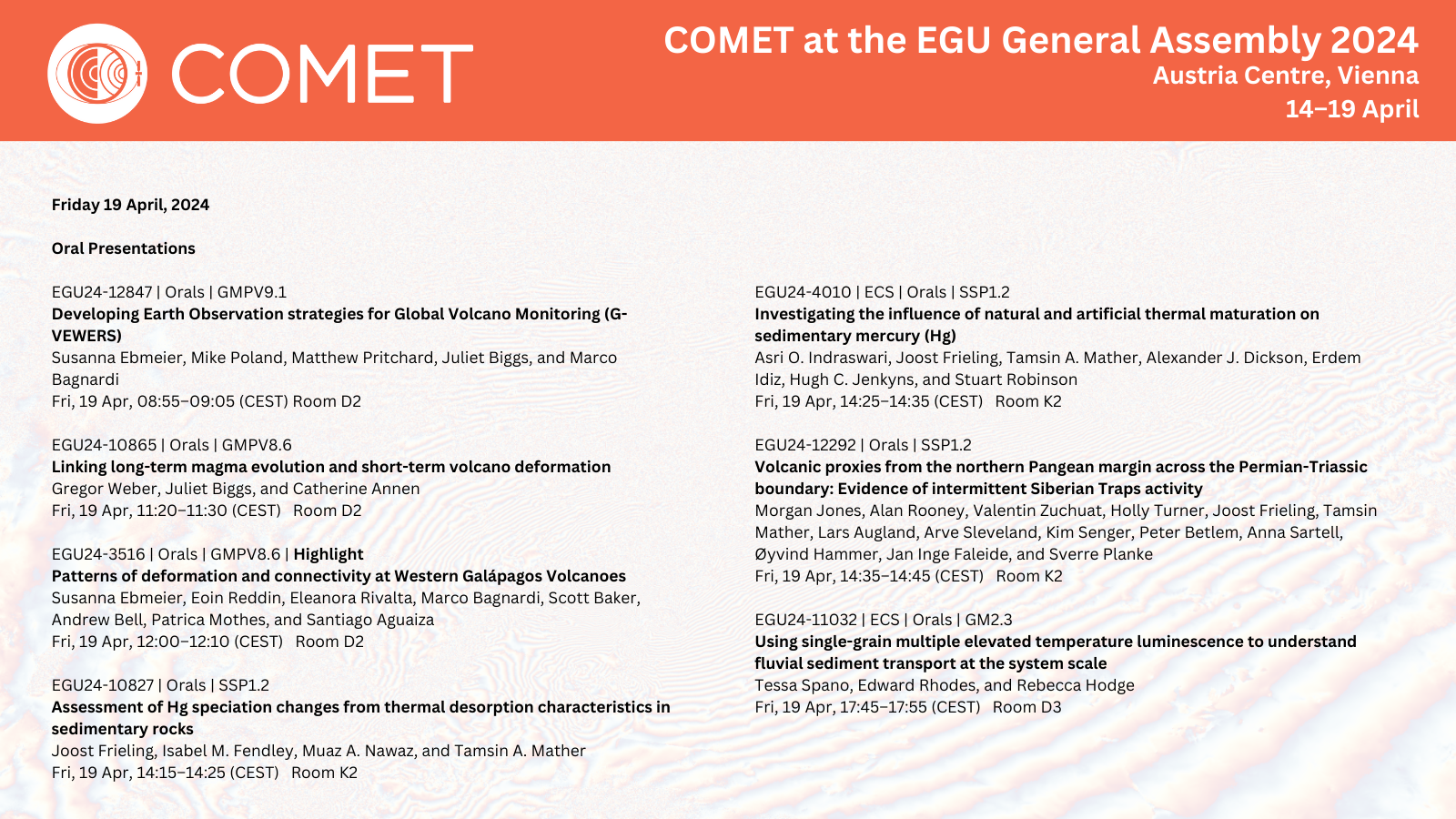
COMET at EGU 2024

Monday 15th April, 2024

Tuesday 16th April, 2024

Wednesday 17th April, 2024

Thursday 18th April, 2024

Friday 19th April, 2024

COMET Celebrates International Women’s Day 2024

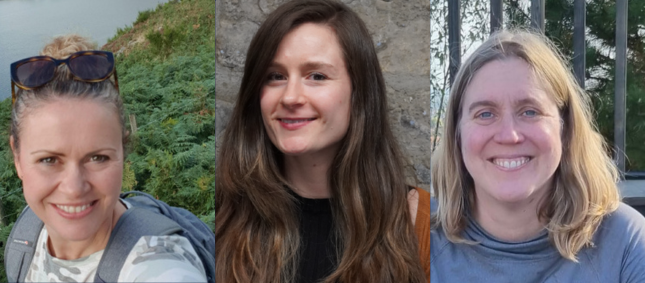
Today we celebrate all our amazing women at COMET and introduce you to some members of the COMET Directorate.

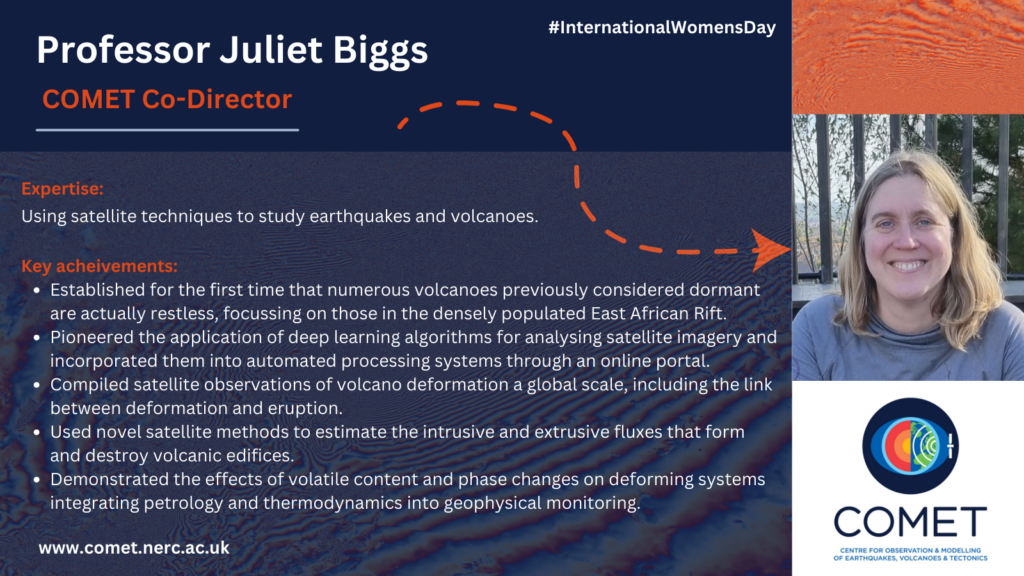
Meet COMET’s Co-Director Professor Juliet Biggs (Bristol), expert in using satellite techniques to study earthquakes and volcanoes.

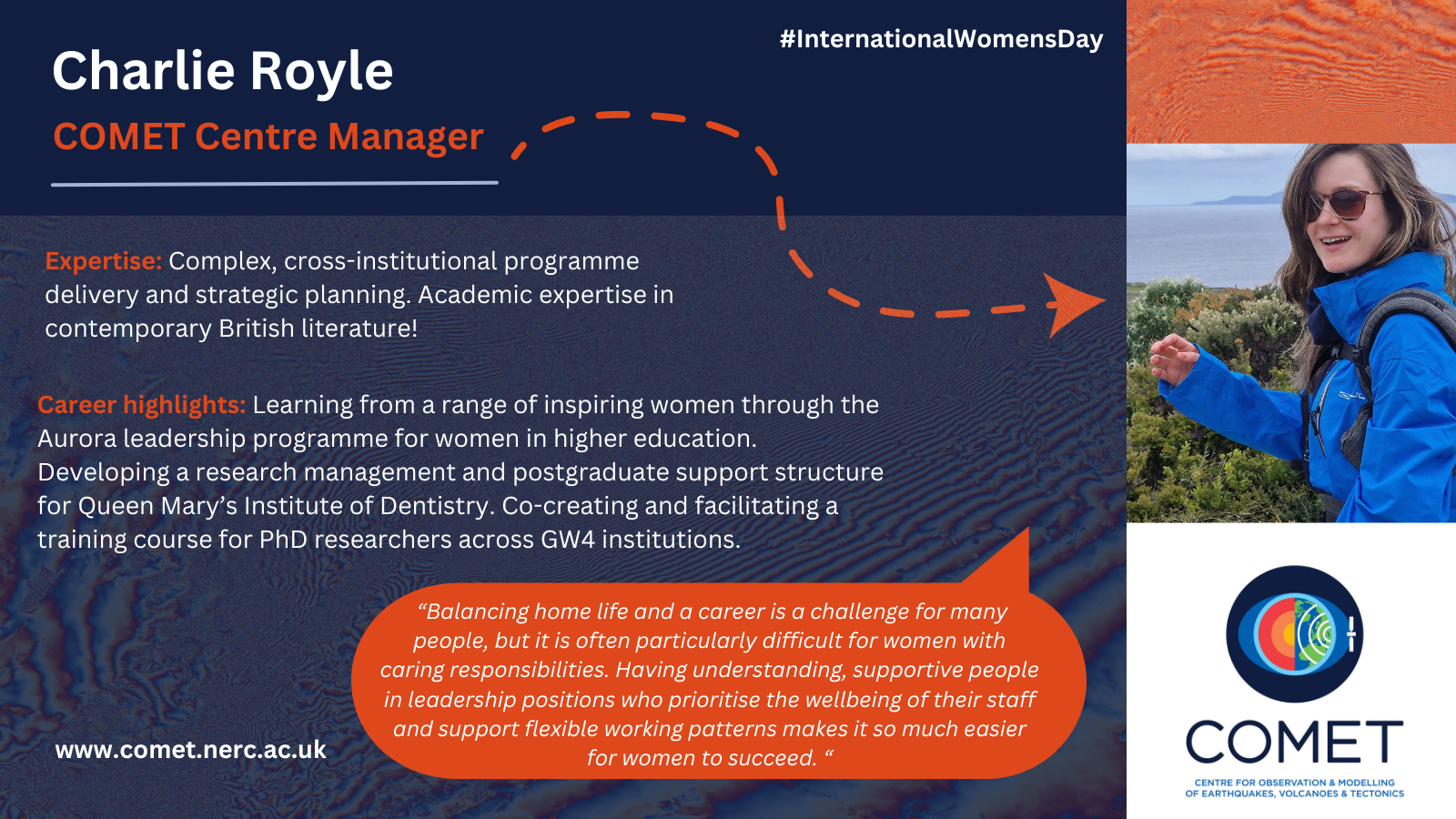
Meet COMET’s Centre Manager, Charlie Royle (Leeds), expert in complex, cross-institutional programme delivery and strategic-planning.

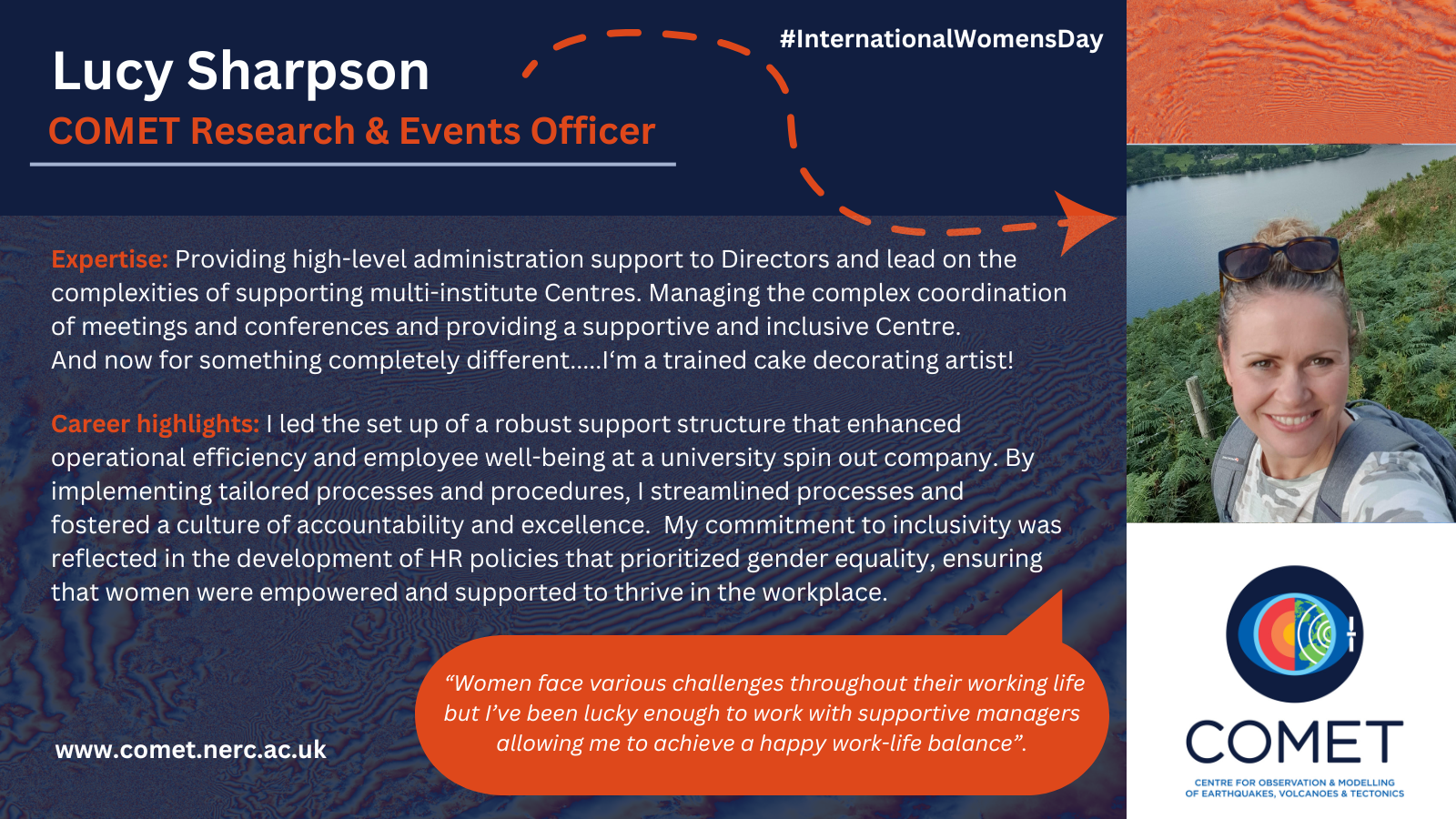
Meet COMET’s Research and Events Officer Lucy Sharpson (Leeds), expert in the complexities of supporting multi-institute Centres and event planning.

Professor David Pyle awarded Geological Society Murchison Medal

COMET Scientist Professor David Pyle (University of Oxford) is the recipient of the 2024 Murchison Medal, awarded by the Geological Society of London for his considerable contributions to the field of volcanology.

The Murchison Medal is awarded to geologists who have contributed significantly to ‘hard’ rock studies.  David is an internationally recognised volcanologist who has made outstanding contributions to understanding volcanic deposits and processes, using pioneering methods to characterise and classify tephra fall deposits and infer erupted volumes.

The Geological Society will host a formal awards ceremony on 12 June with more details of the day to be shared via its magazine Geoscientist, website and social media channels.

Congratulations David from all of your colleagues at COMET!

Observations and models of Icelandic eruption lead to new understanding of volcanic systems

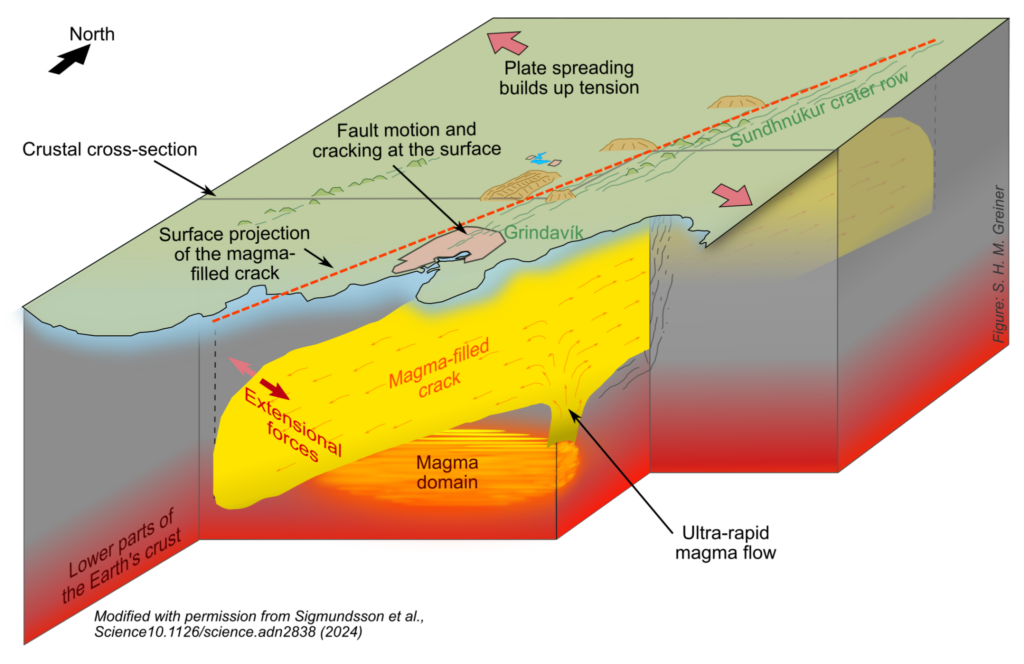
In November 2023, a state of emergency was suddenly declared in a fishing town in Iceland, Grindavík, and all residents were rapidly evacuated. In the space of around 6 hours, escalating seismic activity was felt: large cracks and fault movements occurred at the earth’s surface, and homes, businesses and infrastructure were destroyed.

This devastation was caused by huge amounts of magma moving at an unprecedented speed below the surface, which rushed into a crack that opened up below the town. The intrusion that formed was approximately 15-kilometres-long and extended around 1-5 km deep, with widening of up to 8 meters.

The processes and timescales behind the formation of major cracks, or “dikes”, aren’t currently fully understood but the international team of researchers behind a paper published in Science today have revealed new findings that shed some light on how these hazardous events occur.

Using detailed satellite observations alongside seismic measurements and physical modelling, the team of investigators led by University of Iceland and the Icelandic Meteorological Office, found that the magma flow rate under the surface of the earth reached an ultra-rapid and previously unrecorded speed of 7400 cubic meters per second. The study also shows that huge amounts of magma can be forced into cracks due to fracturing in the earth and tectonic stress, without much pressure coming from underlying magma source that feeds it. These findings demonstrate a significant hazard potential for this volcanic system and others with similar features, which can result in large-volume magmatic eruptions on the surface.

COMET Scientist, Professor Andy Hooper, was a key member of the team of investigators:

“Nothing like these rates of magma flow have ever been measured before. Luckily, the magma did not make it to the surface at that time, but this helps us understand how magma-filled cracks that are tens of kilometres long may have formed in the past.”

The events in November were the beginning of the activity in the affected area around Grindavík. Smaller magma intrusions occurred in December 2023 and January 2024, which unfortunately culminated in large eruptions and further devastation in the town, and a new, ongoing eruption started this morning (February 8th 2024).

Publication available here (open access for all for two weeks): https://www.science.org/doi/10.1126/science.adn2838

Edna Dualeh: 2024 Willy Aspinall Prize

VMSG has recently announced its 2024 award winners and we are delighted to announce that COMET staff researcher Edna Dualeh has been named as the recipient of the 2024 Willy Aspinall Prize for an outstanding paper on applied volcanology.

Edna’s work on St. Vincent was part of her PhD with COMET Scientist Susanna Ebmeier and COMET Director, Tim Wright both based at the University of Leeds.

You can read Edna’s winning paper here: https://doi.org/10.1016/j.epsl.2022.117980

Huge congratulations to Edna from all your colleagues at COMET!

Girls into Geoscience Careers Day

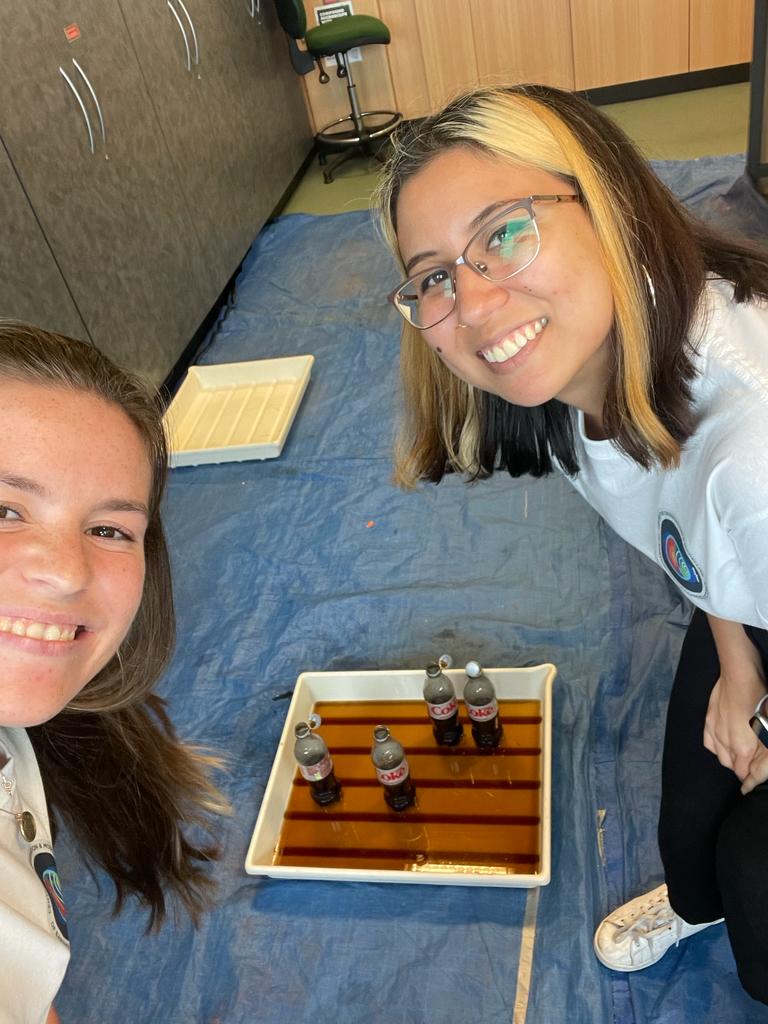
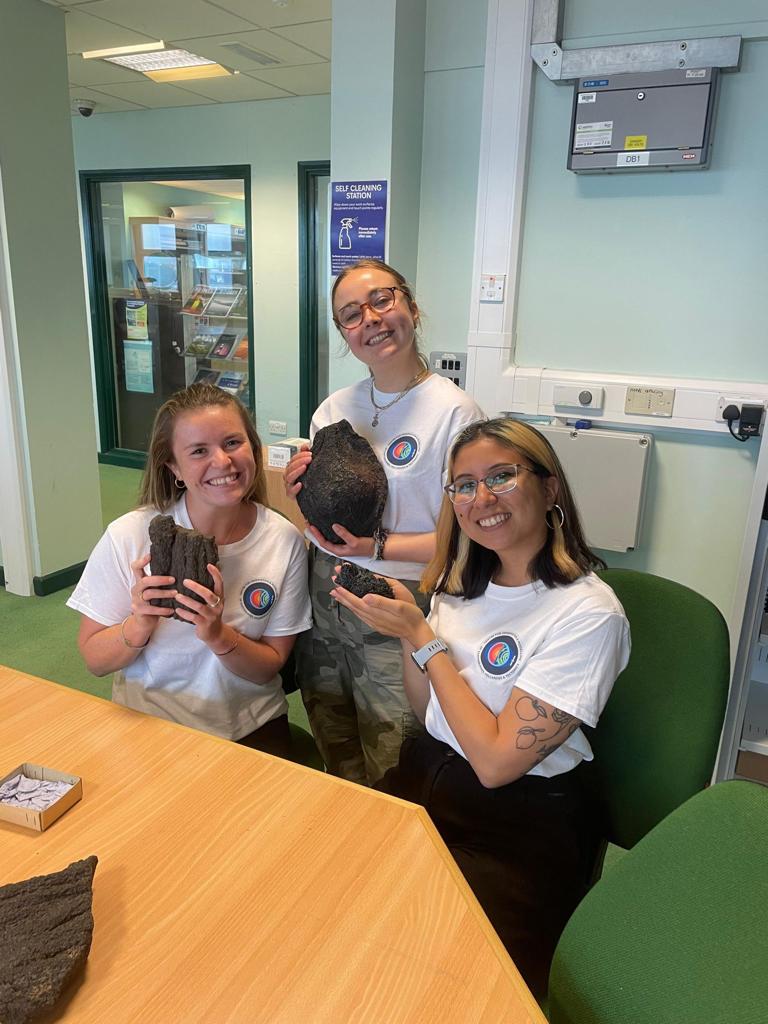
A group from the University of Bristol’s volcanology group represented COMET at the recent Girls into Geoscience careers day at the University of Plymouth. The group, consisting of MSc Volcanology students Alex Daniels, Anne-Marie Molina, Hannah Ellis, and PhD Student Ben Ireland, delivered a workshop showcasing a range of volcanological phenomena.

Anne-Marie and Alex had the following to say about the experience:

“We were at Plymouth University representing COMET for an event called “Girls into Geoscience”, where we talked about the different areas of volcanology to try and encourage these girls to pursue a career in geoscience! We wanted to pique their interest by showcasing volcanic rocks, drone imagery, and had a simulation of a volcanic eruption with a Coke and Mentos experiment. 

 We loved seeing the girls get involved with the interactive activities which they may not have access to in a classroom and loved their questions for us. It was really rewarding to see the girls understand volcanic processes through our experiment and get a sense of the intricacies which take place prior to a volcanic eruption in different settings around the world. This was an amazing opportunity to speak to so many girls with different backgrounds that came together with an interest in geoscience. It felt great to be able to inspire some of them with our own stories and hopefully they’ll pursue a career in geoscience!

 We hope to be back representing COMET at this great event next year!”

‘Sensing Volcanoes’ at the Royal Society Summer Science Exhibition

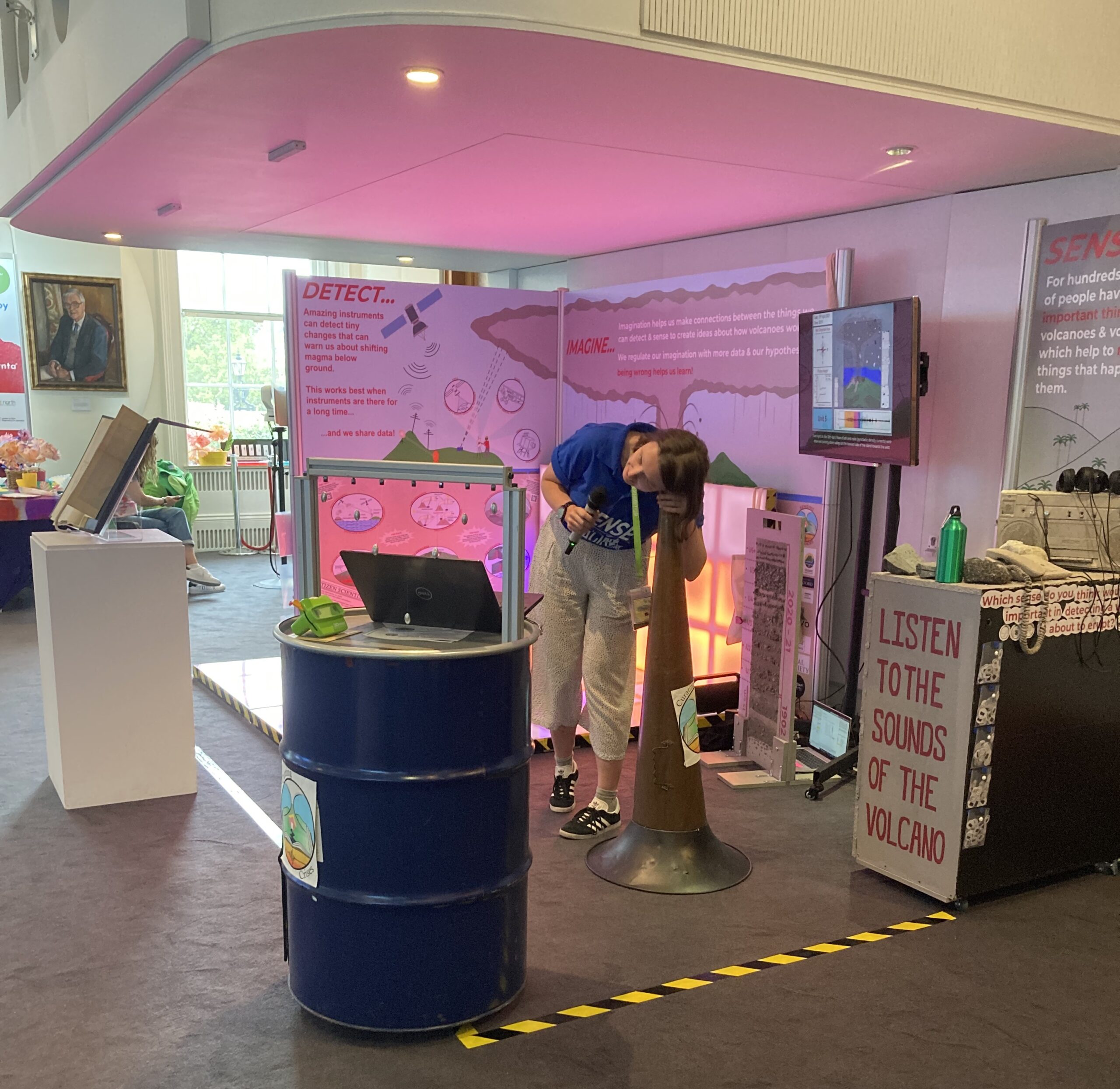
From July 4 – 9 this year, a team from the University of Oxford, University of East Anglia and the University of the West Indies, Seismic Research Centre and Montserrat Volcano Observatory ran a multi-sensory installation as one of nine showcase exhibits at the Royal Society’s summer exhibition. Over six days, thirty volunteers helped to run the installation, manage the enthusiastic crowds of children and adults, and showcase aspects of volcanic and geophysical research.

The exhibit was designed around the ‘Curating Crises’ project funded by AHRC and NERC, which is exploring historical unrest at Caribbean volcanoes using data sources from archives – including the National Archives, the Royal Society, the British Geological Survey and the Montserrat Public Library.

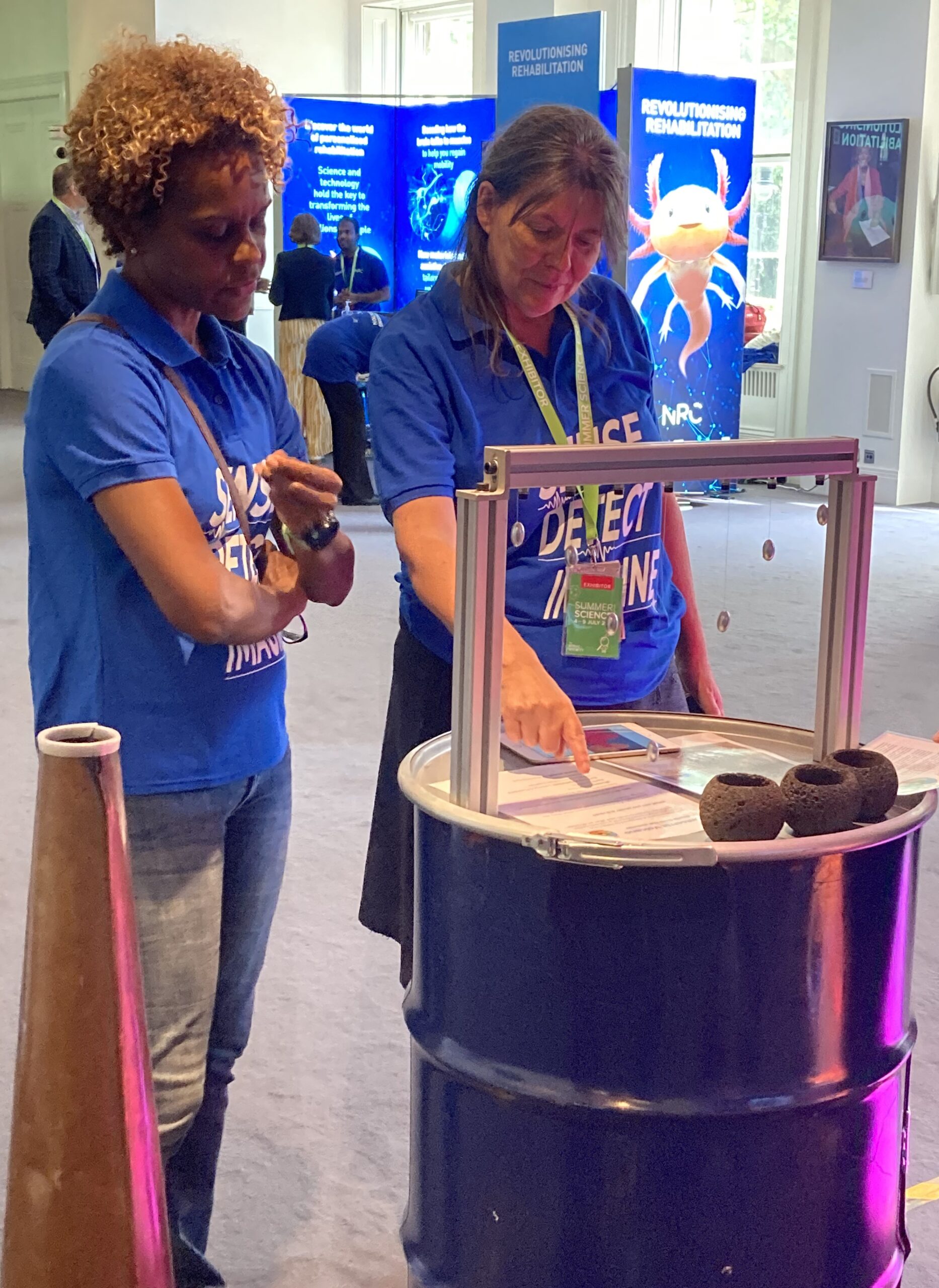
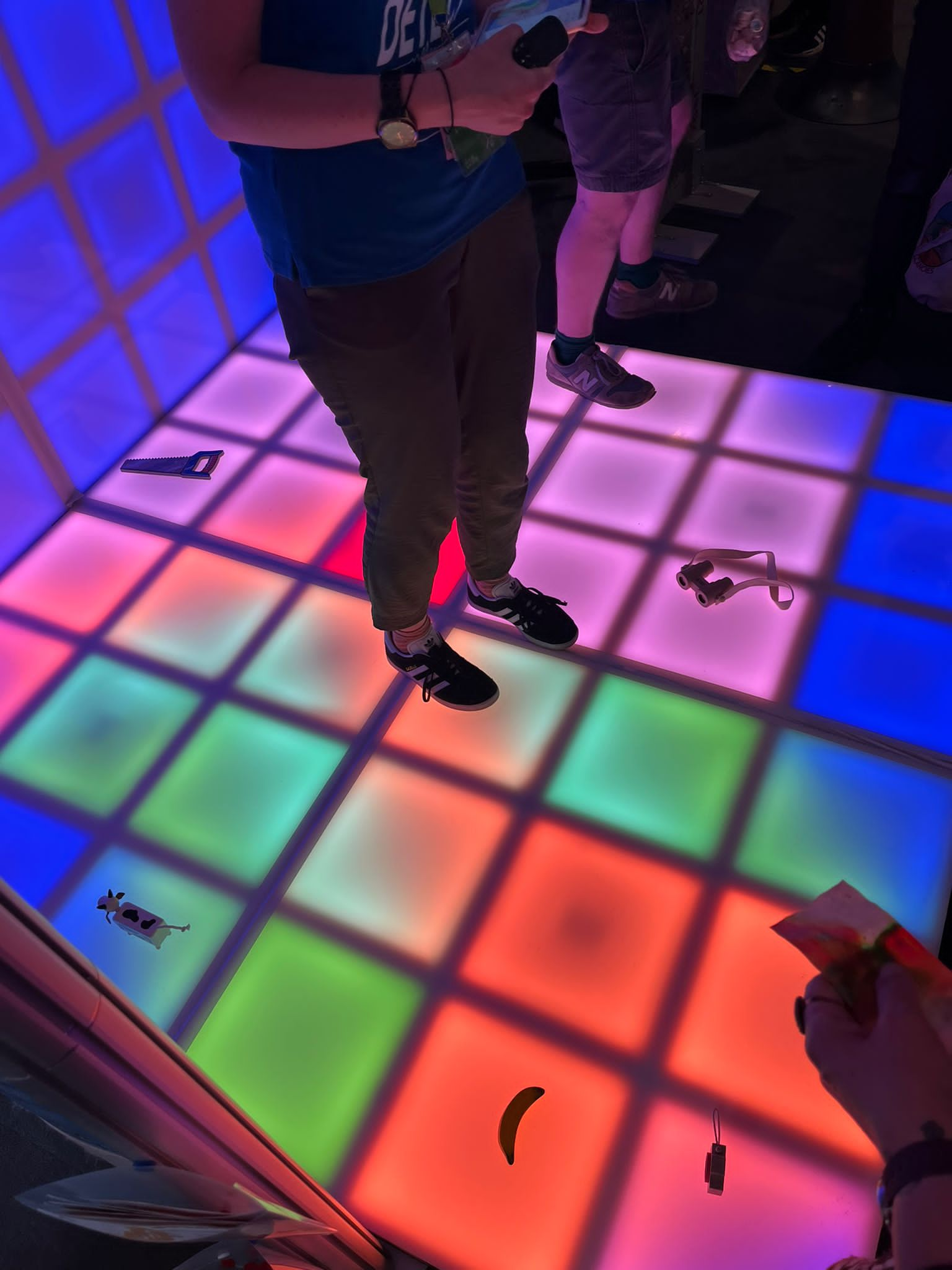
The tag line for the exhibit was ‘sense, detect, imagine’. The idea was to explore how people living near a volcano might sense unrest; and how the detection of unrest feeds into the imagining, or interpretation, of what is happening underground, and what might happen next. To create sensory elements of the installation we had objects including an early 1900’s gramophone trumpet, with the sounds of bubbling geysers; an ash-covered cord telephone (from the 1990’s) with recorded eye-witness accounts of activity on Montserrat, and some tactile pots carved from scoria, impregnated with a mysterious ‘volcano scent’ that had been created for the exhibition. The highlight of the exhibit was the imaginarium – a ‘light up’ floor, controlled by a raspberry Pi. We ran this in two modes – one to represent the seismicity and movement of magma beneath La Soufrière, St Vincent during the 2021 eruption; and the second to run an interactive game on uncertainty and unrest, where the floor transformed into a map view of an island, which then turns out be a volcano.

The exhibit was busy for the whole of the exhibition, with over 4000 visitors to the building over the final weekend alone. Those who dropped by included Janice Panton, the Government of Montserrat representative; Turner-prize winning artist Veronica Ryan, and Cecil Browne, a Vincentian author. The exhibit is portable (with a van!) and will have another outing at the Oxford Festival of Science and Ideas in October.

Thank you to all of our volunteers, funders, and to the artists and creatives – Output Arts, Ωmega ingredients and Lizzie Ostrom – who helped to turn a 2-page vision statement into a physical exhibit in a little over six months!

Written by Professor David Pyle, University of Oxford

Bridie Davies (UEA, now Manchester) checking the sound from the gramophone trumpet.
Stacey Edwards (UWI-SRC) and Jenni Barclay (UEA) checking the pendulum array and smelling stones.
The final stages of the uncertainty game. The volcano on the island has erupted, and places where people have chosen to live (represented by toys) have been affected by ash fallout (purple) or pyroclastic flows (orange).

ESA–EGU 2023 Excellence Award winner Dr Susanna Ebmeier

COMET scientist, Dr Susanna Ebmeier has been recognised at the European Space Agency (ESA)-European Geosciences Union (EGU) excellence awards.

The awards celebrate the innovative use of Earth observation data.

Dr Ebmeier, from the University of Leeds, won the individual award for her work using satellite images to further the scientific understanding of volcanic processes.

Satellite technology means researchers can take measurements that show how the Earth’s surface is moving in volcanic areas with a precision of a few millimetres.

That information means that Dr Ebmeier and her colleagues are able to see how molten rock is moving beneath the Earth’s surface, as well as learn about the growth and stability of volcanoes themselves.

The prize winners, from across Europe, have been celebrated at the EGU’s General Assembly which took place in Vienna on 25 April.

Congratulations to Susi from all your COMET colleagues!

Read more about the ESA-EGU awards

Türkiye-Syria Earthquakes, February 2023 

On 6 February, a 7.8-magnitude earthquake struck the East Anatolian Fault affecting large areas of Southern Türkiye and Northern Syria. This was followed by a 7.5-magnitude event approximately 9 hours later, around 60 miles to the north. To date more than 37,000 people are confirmed to have died, large numbers of people are affected across the region and the damage to buildings and infrastructure is significant.   

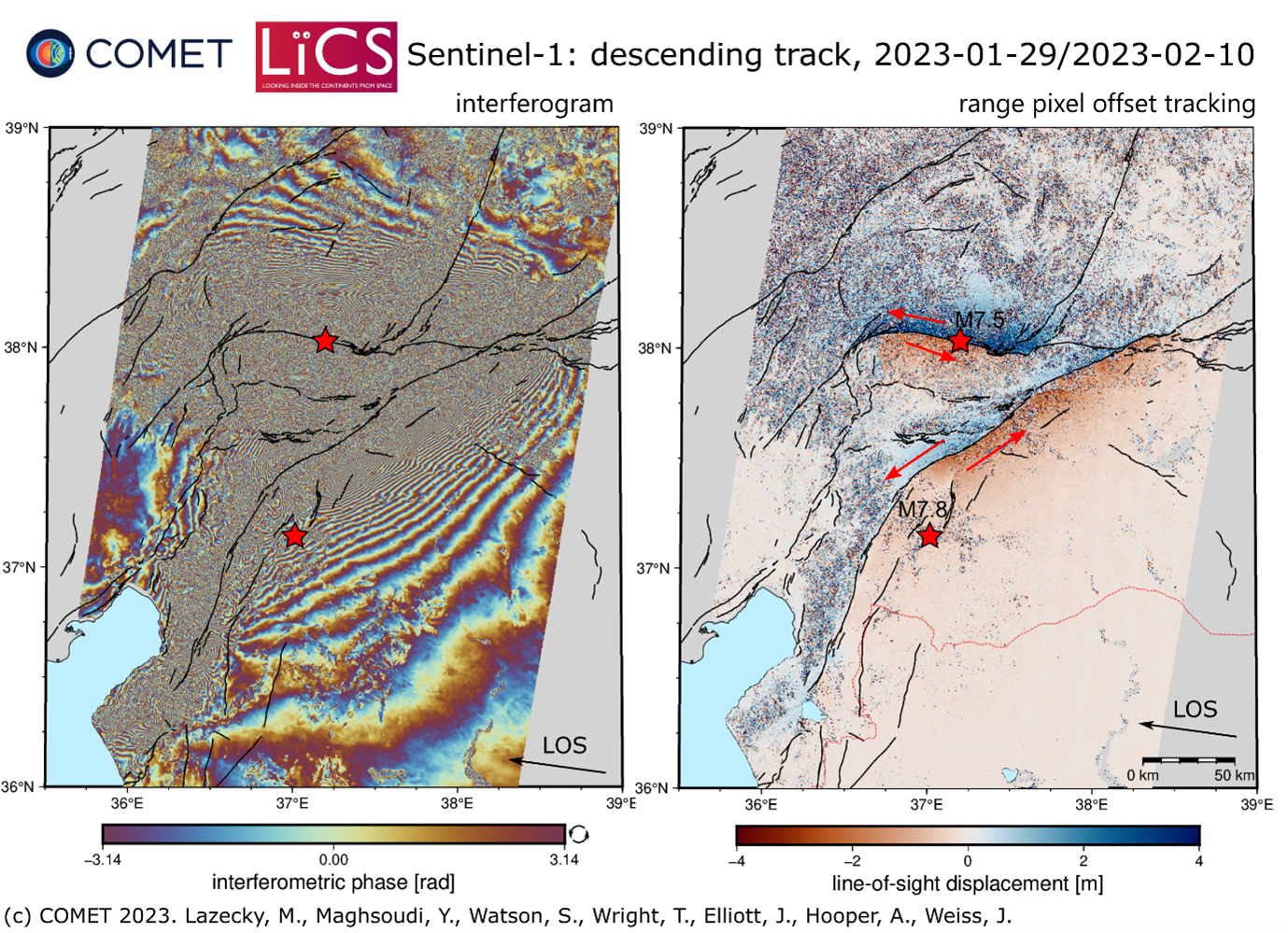
Images from ESA’s Sentinel-1A satellite captured on 9/10 February clearly showed the physical effects of the earthquake on the ground, including deformation of up to 6 metres along a 300km section of the fault, and the second event causing a second ~125km rupture. Many population centres sit close to these zones, explaining the significant human impact of the event.  

By combining Sentinel-1A imagery from before and after the earthquake, COMET scientists have been able to measure surface deformation that is clearly visible in InSAR and pixel offset tracking data sets shown below: 

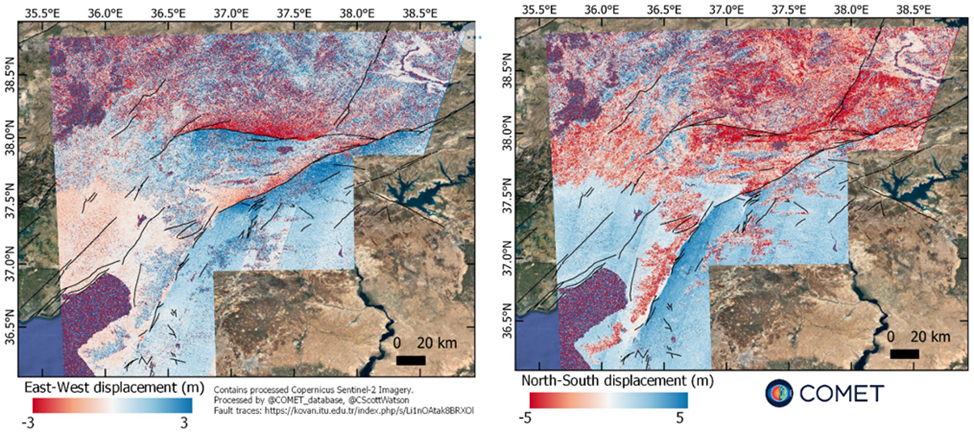
In addition to the results from the satellite radar data, we have also used the pre- and post-event optical images from Sentinel-2 to estimate ground movement in the earthquakes also using pixel tracking: 

The processing outputs from Sentinel-1A data are available for download at our LiCSAR system event page. The results from Sentinel-2 are available here

The images above contain modified Copernicus Sentinel-1 and Sentinel-2 data analysed by the Centre for the Observation and Modelling of Earthquakes, Volcanoes and Tectonics (COMET). Data processing uses JASMIN, the UK’s collaborative data analysis environment (http://jasmin.ac.uk). 

For more information on why and how COMET responds to earthquake events read this article by our Director – Professor Tim Wright. 

COMET – 14 February 2023