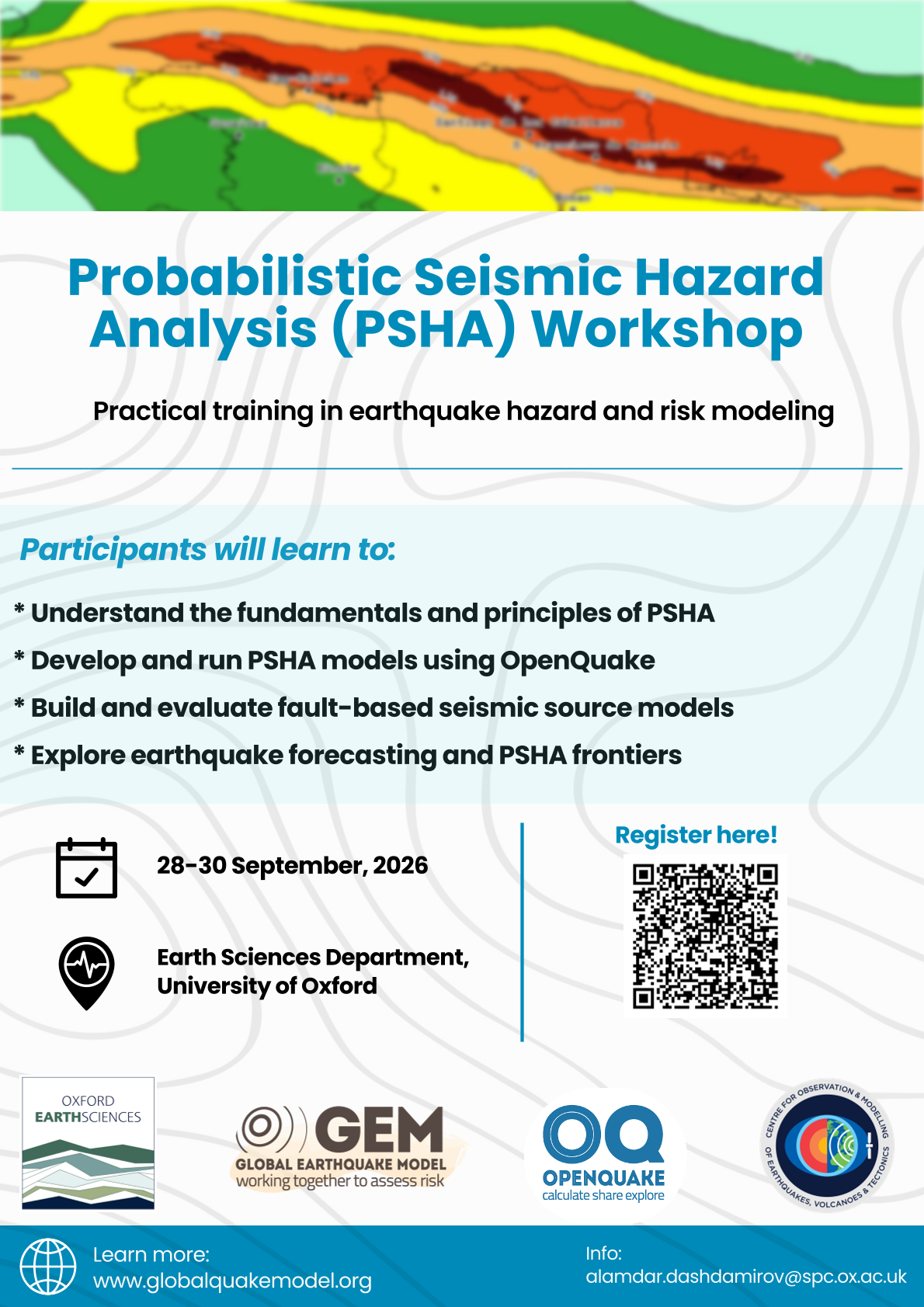
We are delighted to announce that the Global Earthquake Model Foundation (GEM) is providing a 3-day workshop (28-30 September 2026) on Probabilistic Seismic Hazard Analysis (PSHA) at the Department of Earth Sciences, University of Oxford, OX1 3AN, UK. This workshop includes both an introduction to PSHA and discussion about specific topics at the frontiers of both earthquake science and PSHA practice. Participants will learn the basics of PSHA and the use of the OpenQuake tools for developing and running PSHA models, with a focus on fault-based seismic source model development. There will also be time for participants to present their research (on a volunteer basis) as well as ample time to discuss how to advance earthquake forecasting through deeper integration with earthquake science data and theory, in areas such as time dependence, on-fault vs. off-fault strain and seismicity.
This workshop is supported by the Natural Environment Research Council (NERC) through its funding of the UK’s subscription to the Global Earthquake Model Foundation.
Registration
- Registration fee: Free.
- To secure your place, please fill in the online registration form here. The registration form will stay open until 15/09/2026.
Precedence is given to students and academics in UK institutions.
Accommodation
Please note that accommodation is not included, so you’ll need to book your own. As Oxford is a popular tourist destination and late September is a busy time, we strongly recommend booking accommodation as early as possible. A few good places to start looking:
Transportation
Our department is conveniently located within walking distance of Oxford city centre, Oxford Train Station, and Gloucester Green Bus Station, making it easy to reach the workshop on foot from most city centre accommodation. If your accommodation is a little further away, we recommend using local bus services, taxis, or Uber. If you plan to drive to the workshop and require parking, please let us know in advance, as parking availability is limited.
Further practical information will be sent to registered participants closer to the workshop.
If you have any questions or require additional assistance, please contact [email protected] or [email protected].