The UK Centre for Observation and Modelling of Earthquakes, Volcanoes and Tectonics (COMET) invites you to the next instalment of our COMET+ webinar series, viewable from the home office.
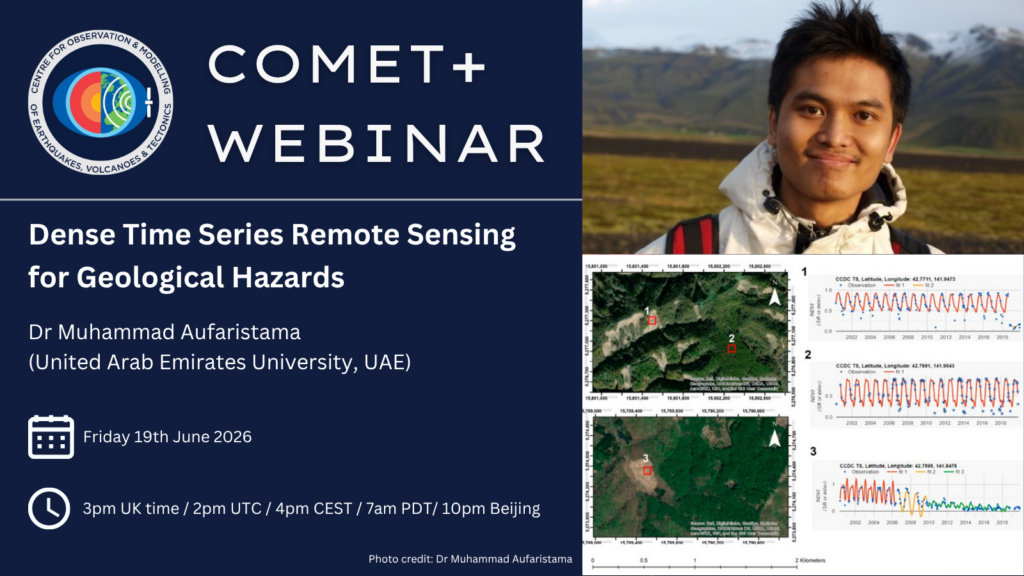
Speaker: Dr Muhammad Aufaristama, United Arab Emirates University, UAE
Title of the talk: Dense Time Series Remote Sensing for Geological Hazards
Date: Friday 19th June 2026
Time: 3pm UK time (2pm UTC / 4pm CEST / 7am PDT / 10pm Beijing)
(After registering, you will receive a confirmation email containing information on how to join the webinar)
Abstract: Dense satellite time series are changing how geological hazards can be observed, shifting the focus from isolated before–after image comparisons to continuous monitoring of disturbance, timing, and recovery. This talk focuses on landslides as a model geohazard and shows how long optical Earth observation archives can be used to detect where failures occur, when they happen, and how affected terrain recovers afterwards. Building on recent work with Continuous Change Detection and Classification (CCDC) in Google Earth Engine and the LandTrendr temporal segmentation framework, I use Landsat-derived NDVI trajectories, together with topographic constraints where appropriate, to identify disturbance–recovery signatures associated with landslide activity. Examples from globally distributed test sites and regional-scale applications in Indonesia demonstrate that dense time series remote sensing can support scalable inventory generation, historical reconstruction, and semi-automated monitoring across diverse environments. The results also highlight key limitations: performance remains sensitive to cloud cover, rapid revegetation, medium-resolution pixel size, and the detectability of small failures. Overall, the work shows that the main value of dense time series lies not only in mapping surface disturbance, but in capturing its temporal evolution, with potential relevance beyond landslides wherever hazards produce measurable surface change.
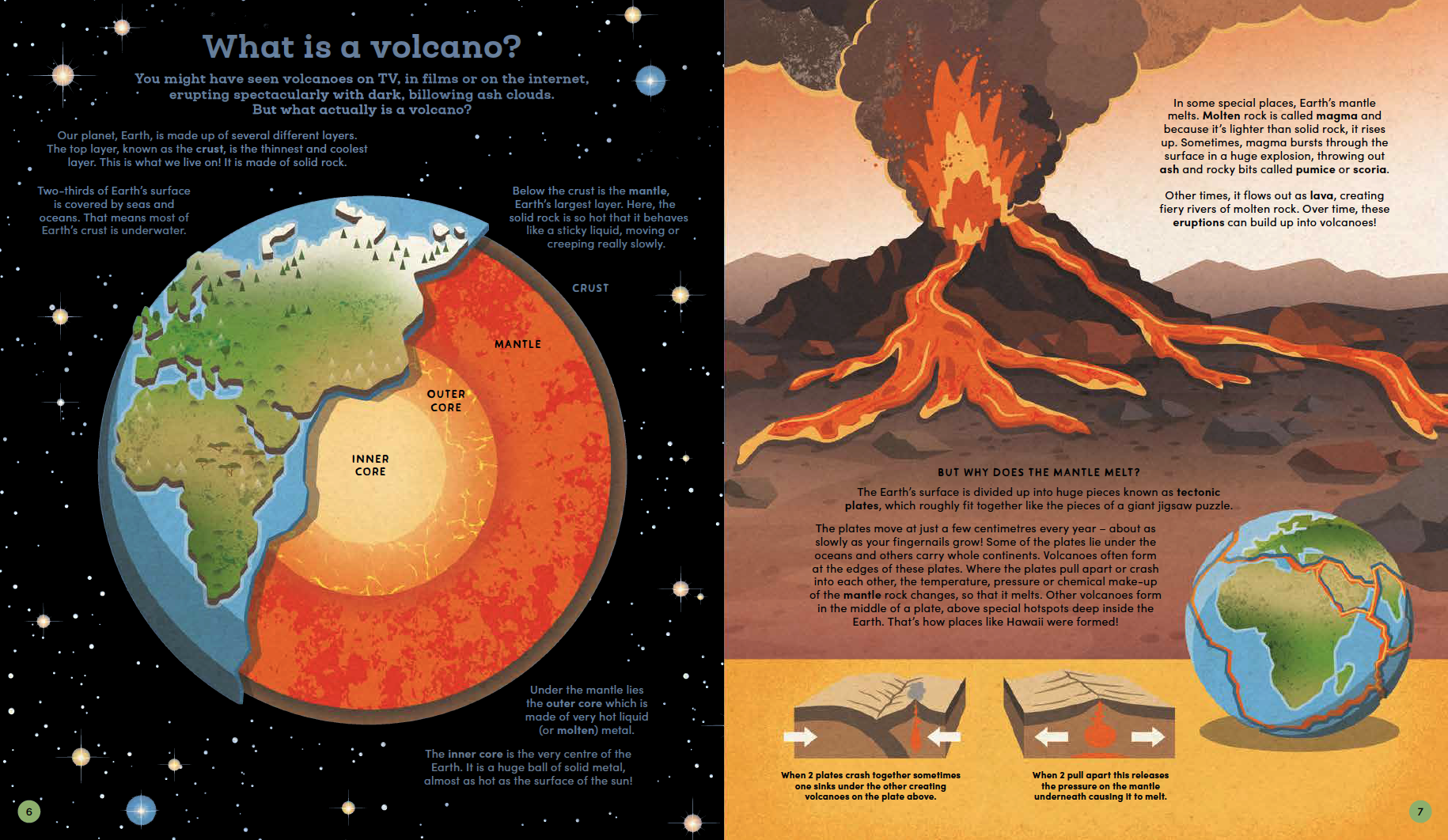
COMET Scientists, Professor Tamsin Mather and Professor David Pyle (University of Oxford) have teamed up with illustrator Daniel Long and publishers Nosy Crow to produce the book ‘Think Big: The Power of Volcanoes’, aimed at 7- to 11-year-olds.
Tamsin said ‘I have always wanted to write a book about volcanoes for younger readers as I think they are such an exciting way to explore thinking more deeply about our and other planets. I think that the best science books for this age group are all about combining words and pictures to tell a scientific story. Daniel’s illustrations are utterly beautiful, capture the science and are really fun to look at too. I love the way he has drawn from old pictures of eruptions as well as lots and lots recent photos of volcanoes. It was fantastic to watch him develop his illustrations around our words!’
David said ‘This was a very rewarding project – starting with the challenge of distilling our technical understanding of “how volcanoes work” into precise but accessible language for the readers. The visuals really make the book come to life. I particularly like Daniel’s images of different rocks in hand-specimen!’
The book published today will be launched with a morning of talks and activities at Oxford’s Natural History Museum this coming Saturday 6th June 2026.
Researchers from the University of Bristol’s COMET group shared new results on volcanic processes and monitoring at EGU 2026 in Vienna.
From May 3–8, members of the COMET group at the University of Bristol, led by Prof. Juliet Biggs (COMET co-director), attended the European Geosciences Union (EGU) General Assembly 2026 in Vienna, Austria. EGU is one of the largest geoscience conferences in the world, bringing together researchers across Earth, planetary, and environmental sciences. This year, our group contributed a wide range of talks, posters, and PICO presentations spanning volcanic deformation, dike intrusion processes, earthquake swarms, geodetic methods, remote sensing, and science communication.
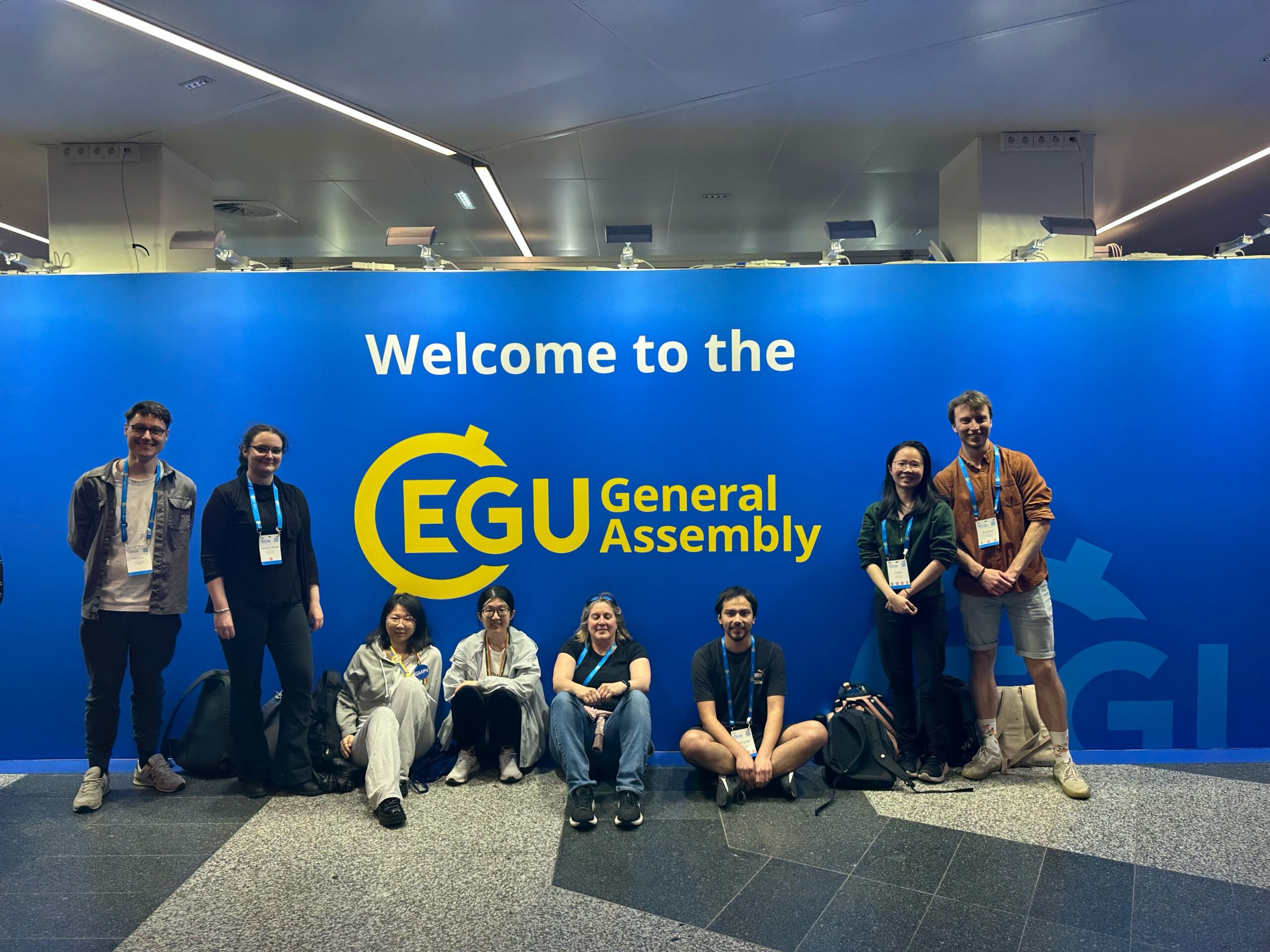
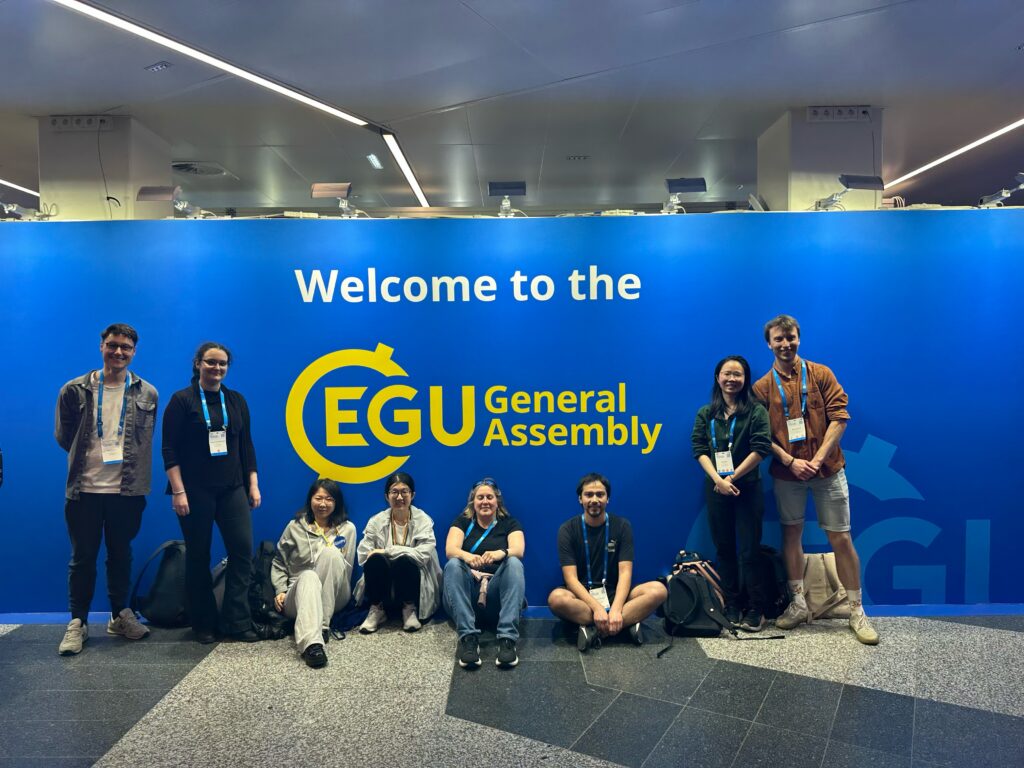
Bristol COMET group members at EGU 2026
It was a busy and exciting week, with presentations spread across many sessions and opportunities to discuss new research with collaborators and colleagues from around the world.
Monday: Modelling and Discussion across Disciplines
The week started with Prof. Juliet Biggs co-chairing the session GMPV10.12 Volcanic processes: tectonics, deformation, geodesy, unrest. The group enjoyed a fantastic series of talks throughout the session and had the opportunity to catch up with colleagues and collaborators from around the world.
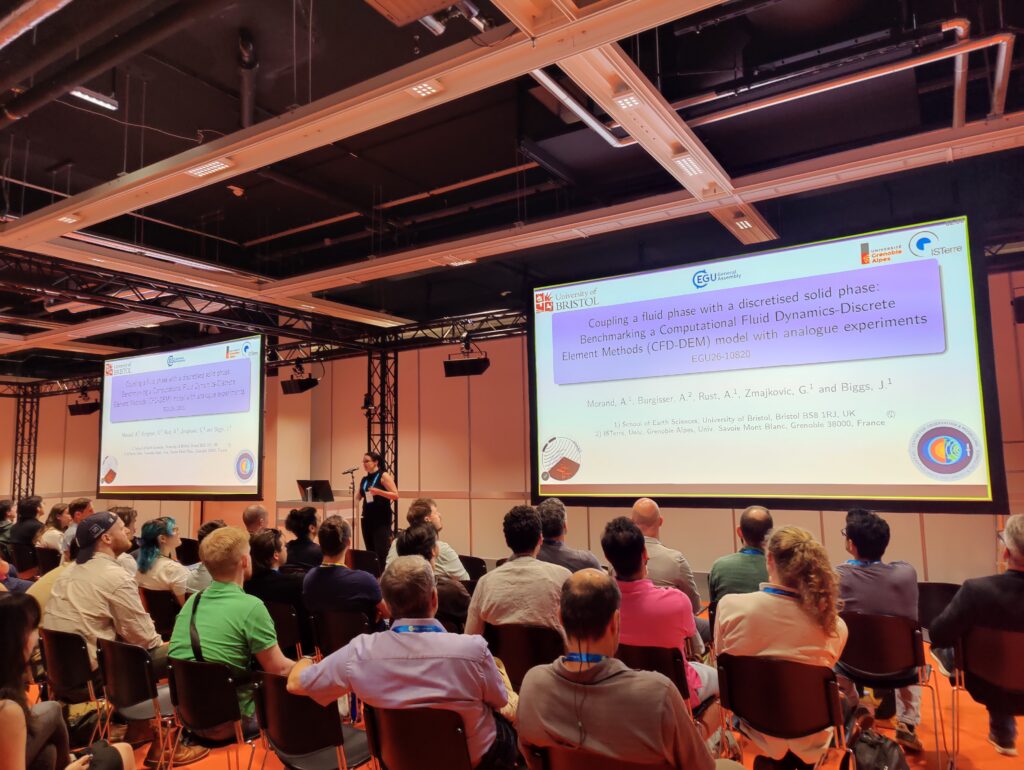
In the afternoon, Alexandra Morand presented her work during the PICO session GMPV12.1 Advances in computational modelling, data analysis, and visualisation. Her work, titled Coupling a fluid phase with a discretised solid phase: Benchmarking a Computational Fluid Dynamics–Discrete Element Methods (CFD-DEM) model with analogue experiments, explored a new numerical modelling framework that couples fluid flow with elastic and brittle deformation of surrounding rocks.
Alexandra presenting her work during the GMPV12.1 PICO session
Tuesday: Seismicity, Deformation, and Magma Transport in the Rift
Tuesday was one of the busiest days of the week, with multiple group members presenting across different sessions spanning seismology, rifting, and remote sensing.
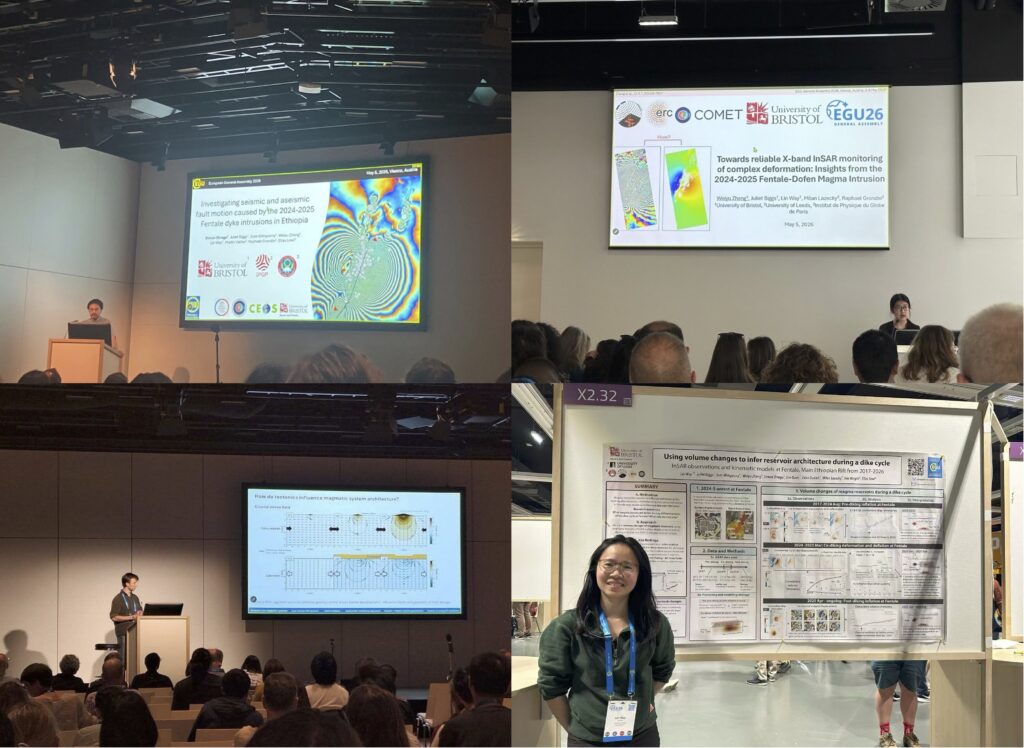
The day started early with Simon Orrego presenting in TS1.8 Seismic and aseismic fault deformation. His talk, Investigating seismic and aseismic fault motion caused by the 2024–2025 Fentale dyke intrusions in Ethiopia, provides new constraints on fault mechanics and the interaction with magmatic processes in rifting environments.
Later in the afternoon, Weiyu Zheng presented in the session GI6.1 Remote sensing for environmental monitoring. The talk, Towards reliable X-band InSAR monitoring of complex deformation: Insights from the 2024-2025 Fentale-Dofen Magma Intrusion, focused on improving InSAR unwrapping results for complex volcanic deformation, particularly during dike intrusion events.
Immediately afterwards, Ben Ireland presented in TS2.1 Rift evolution: from continental inception to seafloor spreading. The talk, Along-rift variations in magma system geometry observed using Sentinel-1 InSAR data from the East African Rift System, highlighting that magma systems along the East African Rift evolve from horizontally to vertically dominated geometries, indicating structural differences in magmatic system architecture.
The day concluded with Lin Way presenting her poster in GMPV10.12 Volcanic processes: tectonics, deformation, geodesy, unrest. Her presentation, Reservoir connectivity in a continental rift: Insights from geodetic observations during the 2024-2025 dike intrusions at Fentale, Main Ethiopian Rift, showed that tracking the evolving volume ratio between dike intrusion and magma reservoir deflation provides new insights into changes to the magmatic system.
Tuesday presentations from Simon, Weiyu, Ben and Lin
Wednesday: Science into Policy
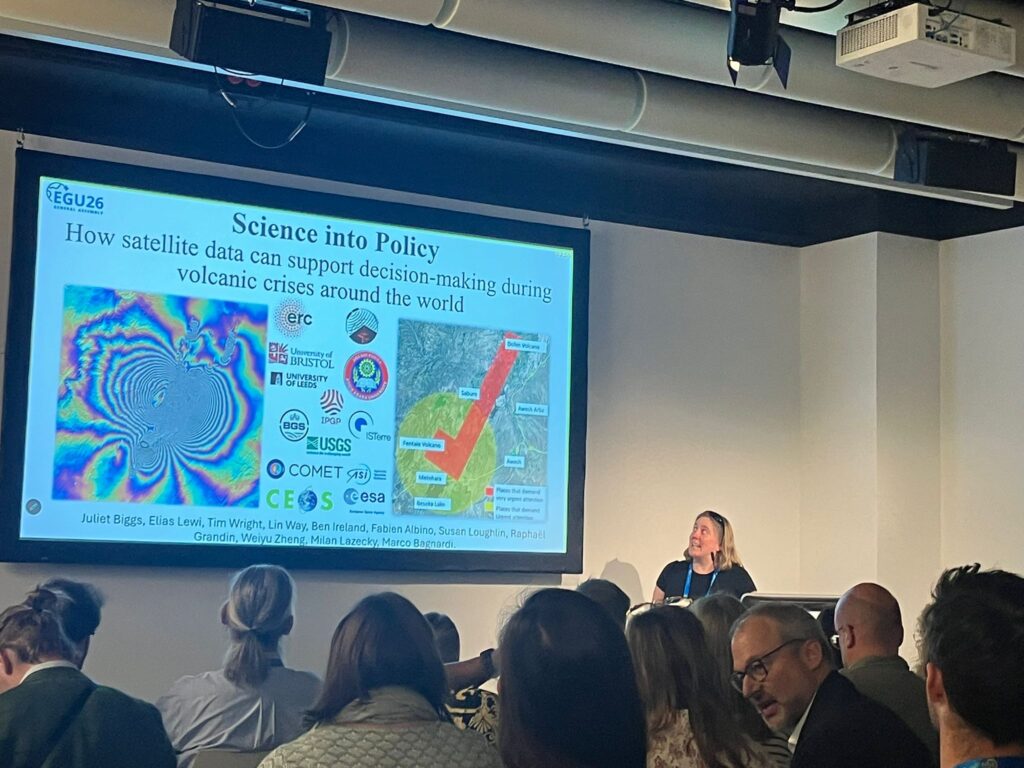
Wednesday is featured by Prof. Juliet Biggs presenting in the session EOS4.6 Strengthening Policy Through Science: Insights from the interface. Her talk, Science into Policy: how satellite data can support decision-making during volcanic crises around the world – a recent example from East Africa, highlighted how satellite observations and geodetic analysis can directly support decision-making during volcanic crises.
Juliet presenting in the session EOS 4.6
Thursday: Dyke Seismicity and Geodetic Methods
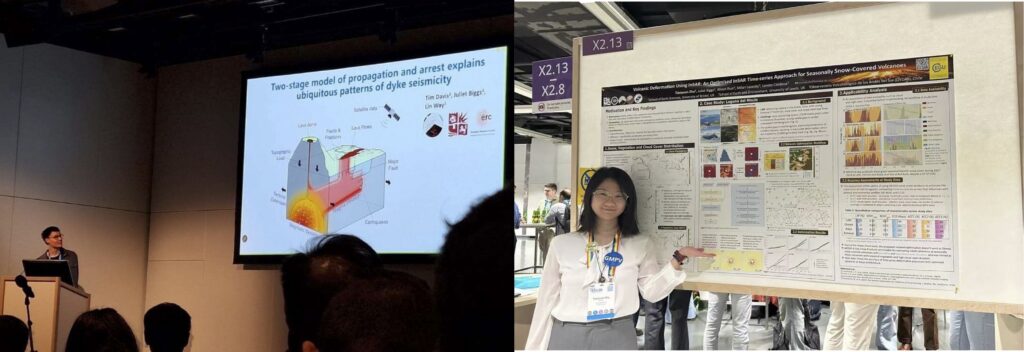
Thursday started with Tim Davis presenting in SM7.1 Beyond the Catalog: Unraveling the mechanisms of Earthquake Swarms and Sequences in Tectonic and Volcanic Regions. The session began with two talks on the seismicity of the 2025 Santorini intrusion, leading nicely into his talk, Two-stage model of propagation and arrest explains ubiquitous patterns of dyke seismicity. Heshowed that a 3D hydromechanical model can explain the observed patterns of dyke-related seismicity and deformation across multiple intrusions both before and after arrest.
In the afternoon, Tianyuan Zhu presented her poster in G3.3 Space, Land and Marine geodetic methods to advance lithospheric processes understanding and hazards assessment. Her presentation, Monitoring Volcanic Deformation Using InSAR: An Optimised InSAR Time-Series Approach for Seasonally Snow-Covered Volcanoes, focused on improving InSAR time-series analysis in seasonally snow-covered volcanic regions, enhancing the reliability of deformation measurements in challenging environments.
Thursday presentations from Tim and Tian
Friday: Volcanic Emissions
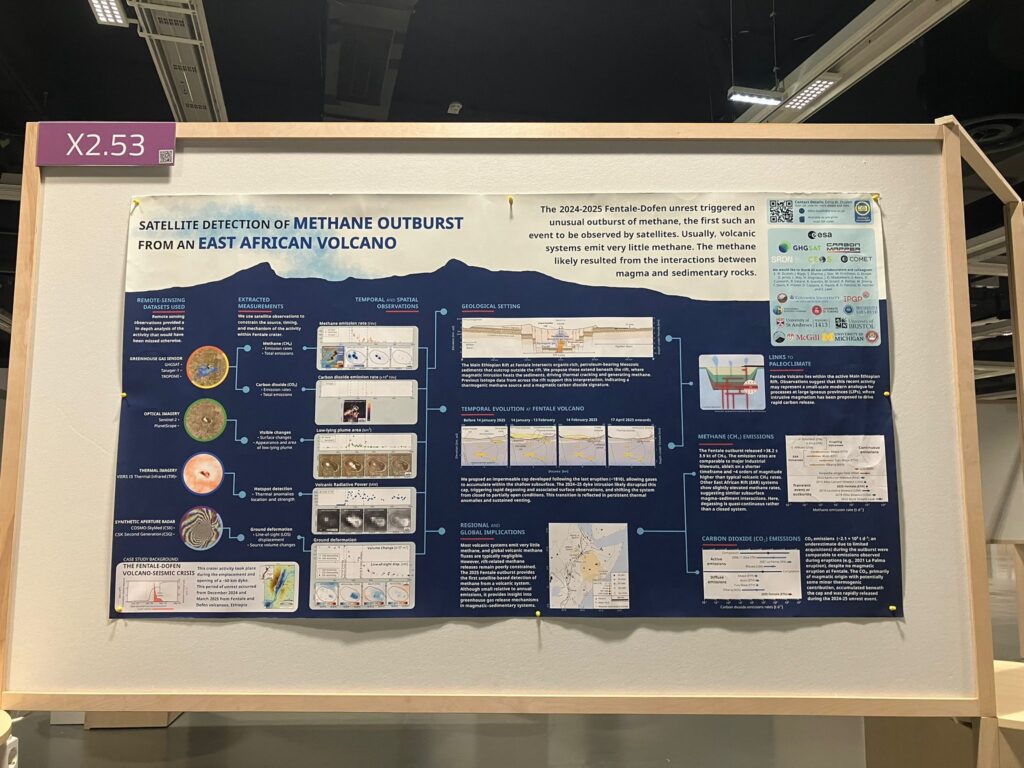
The week concluded with Edna Dualeh’s poster in the session GMPV11.5 Volcanic Eruptions and Climate: Observations. Her work, Satellite detection of methane outburst from an East African volcano, showed the first satellite observations of large, transient methane emission associated with magma–sediment interactions during a volcanic intrusion. Although Edna was unable to attend EGU, her work, presented on her behalf by Tim, attracted strong interest and discussion throughout the session.
Edna’s poster in session GMPV 11.5
Concluding remarks
EGU 2026 was a busy and rewarding week for the Bristol COMET Group, with contributions across oral, poster, and PICO sessions covering a wide range of topics in volcanology, tectonics, remote sensing, and decision support. It was an excellent opportunity to share new results, exchange ideas, and receive feedback from colleagues working on similar problems around the world. Beyond the presentations, the meeting also provided valuable time for the group to catch up with collaborators and discuss ongoing and future research in an inspiring scientific environment.
Manage Consent
To provide the best experiences, we use technologies like cookies to store and/or access device information. Consenting to these technologies will allow us to process data such as browsing behavior or unique IDs on this site. Not consenting or withdrawing consent, may adversely affect certain features and functions.
Functional
Always active
The technical storage or access is strictly necessary for the legitimate purpose of enabling the use of a specific service explicitly requested by the subscriber or user, or for the sole purpose of carrying out the transmission of a communication over an electronic communications network.
Preferences
The technical storage or access is necessary for the legitimate purpose of storing preferences that are not requested by the subscriber or user.
Statistics
The technical storage or access that is used exclusively for statistical purposes.The technical storage or access that is used exclusively for anonymous statistical purposes. Without a subpoena, voluntary compliance on the part of your Internet Service Provider, or additional records from a third party, information stored or retrieved for this purpose alone cannot usually be used to identify you.
Marketing
The technical storage or access is required to create user profiles to send advertising, or to track the user on a website or across several websites for similar marketing purposes.