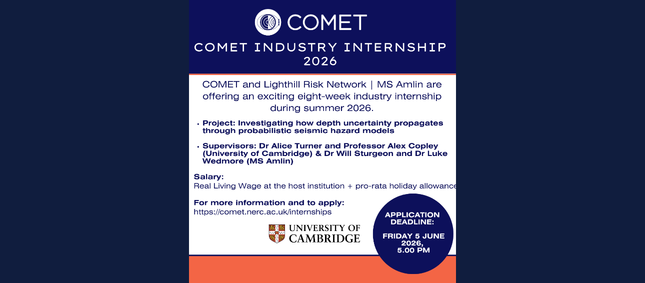
We’re excited to share an 8‑week paid summer industry internship with COMET and Lighthill Risk Network | MS Amlin, open to 2nd–4th year undergraduates with the Right to Work in the UK.
Research project: Investigating how depth uncertainty propagates through probabilistic seismic hazard models
Supervisors: Dr Alice Turner and Professor Alex Copley (University of Cambridge) & Dr Will Sturgeon and Dr Luke Wedmore (MS Amlin)
Global earthquake catalogues are automatically-generated, and are known to poorly
constrain earthquake depths. Recent results (e.g., Wimpenny and Watson, 2021) have
shown that where more accurate techniques are used, involving human input, much more
accurate depth estimates can be obtained, and these often differ by more than 10 km
from those in the catalogues. This difference has huge implications when assessing
earthquake hazard, because of the extreme sensitivity of ground-shaking to the depth of
the causative earthquakes. Hazard assessments are often undertaken using Ground
Motion Prediction Equations (GMPEs), using poorly-constrained catalogue depths as
input constraints for the likely depths of future events.
This project will assess the effects of using accurately-constrained earthquake depths on
the assessment of earthquake hazard. It will focus on the North Anatolian Fault Zone in
Turkey, which hosts large, damaging earthquakes in close proximity to major population
centres.. Over the 8 weeks of the placement, the student will determine accurate depths
of earthquakes in the region (data collection). They will then estimate earthquake hazard
metrics from both the accurately-determined depths, and the previously-used poorly
constrained catalogue depths, and thereby establish how earthquake depth accuracy
influences hazard assessment.
How to Apply:
Eligibility: To be eligible for this scheme you must: (1) be a current 2nd-4th year
undergraduate student with no prior research internship experience, and (2) hold the right
to work in the UK. Earth Sciences is the least diverse STEM subject, and therefore we
strongly encourage applicants from minority backgrounds and those who are the
first generation in their families to have attended University.
Salary: Interns will be paid at the Real Living Wage at the host institution (£470 pw, 35
hours per week) with pro-rata holiday allowance and a small expense budget to facilitate industry collaboration.
Application form: Apply via the application form (takes around 20 minutes to complete)
Application deadline: Friday 5 June 2026, 5.00pm