The 2013 Mw 7.7 Balochistan earthquake in Pakistan: Not so unusual

The 2013 Mw 7.7 Balochistan earthquake in Pakistan: Not so unusual

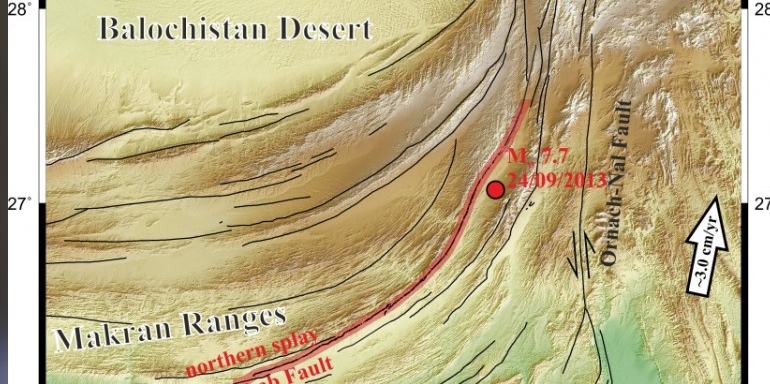
In 2013, a MW7.7 earthquake struck Balochistan, caused a huge surface offset and triggered a small tsunami in the Arabian Sea.

The apparently strange fault behaviour attracted the attention of scientists worldwide and discussion is still ongoing.

This an interesting case for paleoseismologists, not only because of the cascading earthquake effects, but also because of the surface rupture distribution, from which we might learn some important lessons.

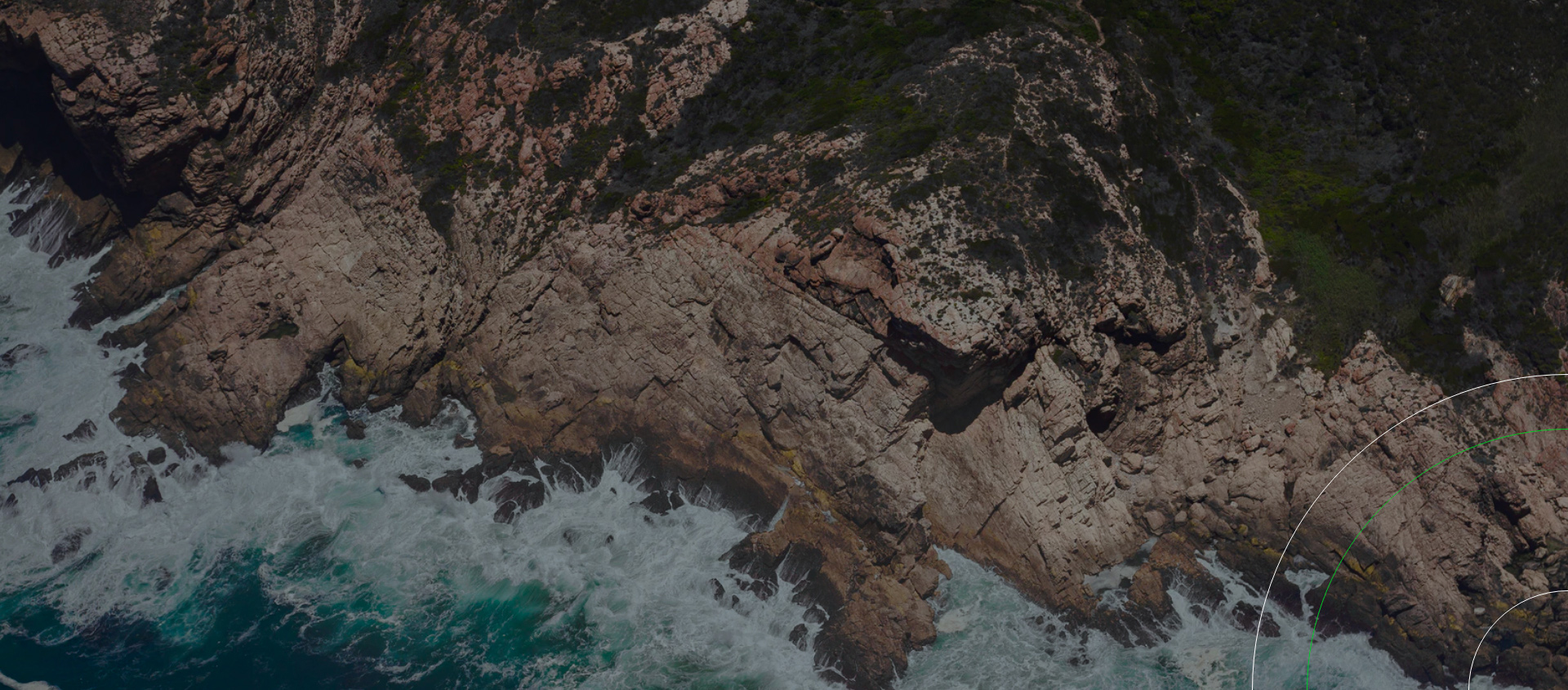
COMET student Yu Zhou and his colleagues from Oxford University have published a new paper on this event, arguing that it might be not as unusual as it seems. Their research is based on the analysis of Pleiades stereo satellite imagery, which has proven to be a very useful data source.

You can read Yu’s blog on the palaeoseismicity.org website.

Dr Paola Crippa awarded L’Oréal-UNESCO For Women In Science Fellowship

COMET Research Associate Dr Paola Crippa, from the University of Newcastle, has been awarded a prestigious L’Oréal-UNESCO National For Women In Science Fellowship.

This programme encourages greater participation of women in science across the globe by promoting and rewarding outstanding female postdoctoral researchers.

One of five winners, Paola was selected by a jury of eminent scientists, chaired by Professor Pratibha Gai who was L’Oréal’s International Laureate in 2013.

Her research, focusing on particulate matter transportation and implications for human health,  integrates model results with satellite data to more accurately predict population exposure to harmful concentrations of particulate matter.

Paola will not only benefit from financial support for her research, but also a raft of career and life enhancing experiences such as media training, personal impact coaching, speaking opportunities, networking events and access to senior mentors and role models.

Congratulations Paola from all at COMET.

Professor James Jackson Awarded CBE in Queen’s Birthday Honours

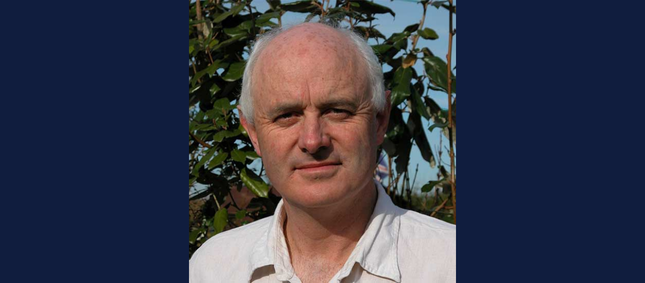
Congratulations to COMET’s James Jackson who has received a CBE for his services to environmental science.

As well as being Head of the Department of Earth Sciences at Cambridge, James was one of the founding members of COMET and has been a major contributor to its ongoing success.

James has pioneered the combination of earthquake source seismology, geomorphology, space geodesy and remote sensing to examine how the continents are deforming, looking at scales that range from single earthquakes to the vast continental areas of active plate movement such as Africa, Iran and the Aegean.

He is also currently leading the Earthquakes without Frontiers (EwF) project, which brings together Earth and social scientists, science communicators, policy makers and local and regional organisations to increase resilience to earthquakes in countries across Asia.

Following the devastating earthquakes earlier this year, Following the devest the EwF team has been working with colleagues in Nepal with a view to improving resilience to future earthquakes, not just in Nepal and neighbouring countries, but also for earthquake-prone nations across the globe.

COMET Director Tim Wright said “James has had a huge influence on many of us as a scientist, teacher, and colleague, and I congratulate him on this latest award ”.

Earlier this month, James also received the Wollaston Medal, the highest award given by the Geological Society.

Well done James from all at COMET, we wish you continued success.

Notes:  Professor James Jackson is Head of the Department of Earth Sciences at the University of Cambridge and also a Fellow of the Royal Society (FRS).  You can read more about James and his work here.
COMET wins two The Geological Society awards (2015)

Two COMET scientists received prestigious awards from the Geological Society of London.

The Society, which has been recognising significant achievements in the Earth sciences since 1831, presented its Wollaston Medal (its highest award, for impacts on pure or applied geology) to COMET’s James Jackson, Professor of Active Tectonics at the University of Cambridge.

Professor Jackson’s work includes research into active tectonics in New Zealand, Iran, Turkey, Greece and Tibet, where he has made vital contributions to understanding the evolution and deformation of the continents, from individual faults to mountain belts.

Professor Geoff Wadge of the University of Reading received the Murchison Medal, awarded to geologists who have contributed significantly to ‘hard’ rock studies.  Professor Wadge was recognised for his contributions to geology and remote sensing, including research into volcanology, Caribbean tectonics, and volcanic hazards and risk assessment. The awards were presented by Geological Society President Professor David Manning at their President’s Day on 3 June 2015.

Sentinel maps Nepal earthquake 2015

On 25 April, a 7.8-magnitude earthquake struck Nepal, claiming over 8,000 lives and affecting millions of people.

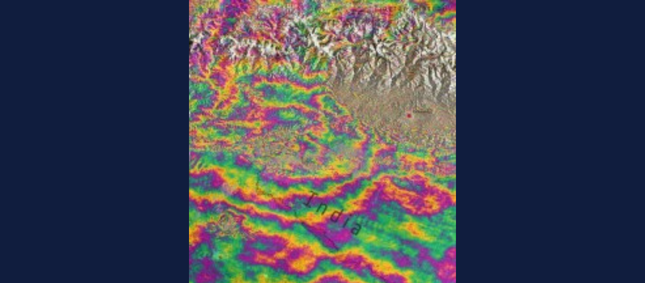
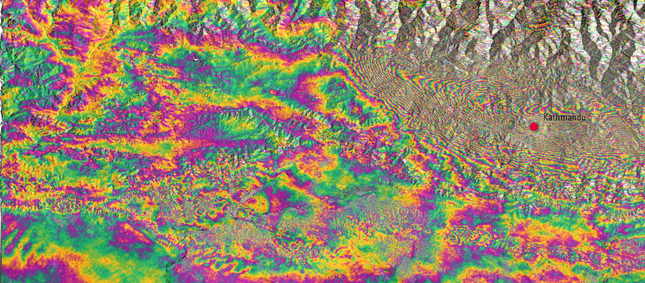
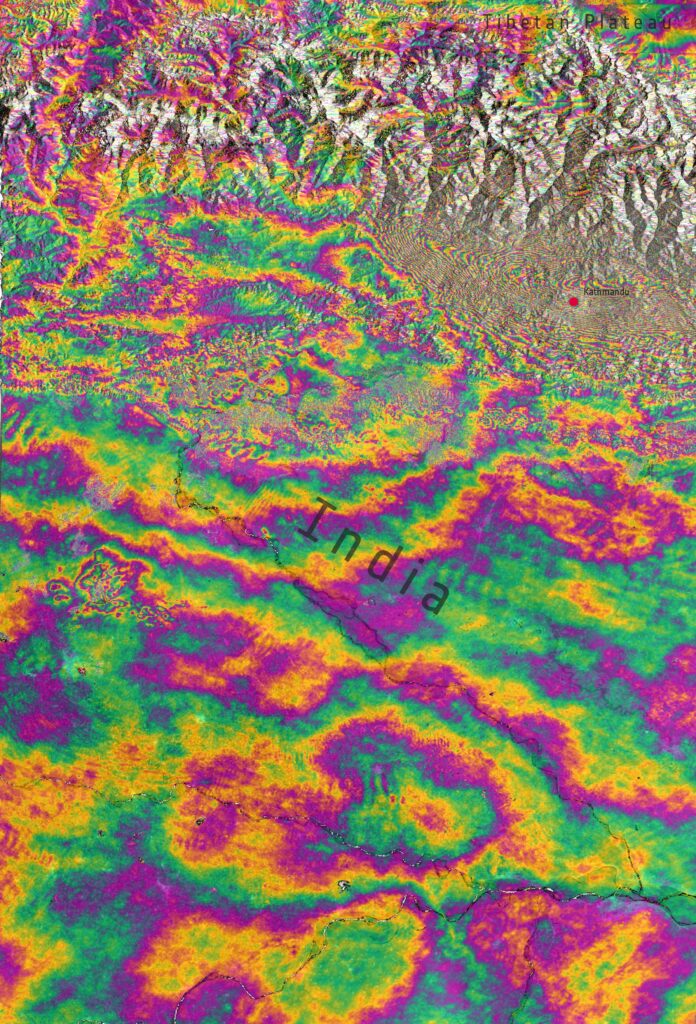
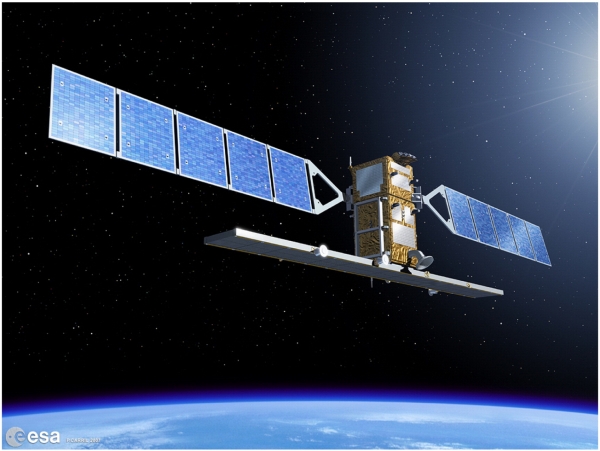
Images from ESA’s Sentinel-1A satellite clearly showed the effects of the earthquake, including the maximum land deformation only 17km from Nepal’s capital, Kathmandu.  This explains the extremely high damage to the area.

Nepal earthquake April 2015.  Credit: Copernicus data (2015)/ESA/Norut/PPO.labs/COMET–ESA SEOM INSARAP study
Nepal earthquake April 2015. Credit: Copernicus data (2015)/ESA/Norut/PPO.labs/COMET–ESA SEOM INSARAP study

By combining Sentinel-1A imagery from before and after the quake, COMET scientists have been able to interpret the rainbow-coloured interference patterns in the image (known as an interferogram), and interpret them as changes on the ground.  COMET scientists have also been analysing the 12 May aftershock.  You can read more here.

Nepal earthquake

COMET scientists have been closely involved with international efforts to analyse satellite data from the recent Nepal earthquake.

Combining two Sentinel-1A radar scans from 17 and 29 April 2015, this interferogram shows changes on the ground that occurred during the 25 April earthquake that struck Nepal. An overall area of 120×100 km has moved – half of that uplifted and the other half, north of Kathmandu subsided. Vertical accuracy is a few cm. Credit: Copernicus data (2015)/ESA/Norut/PPO.labs/COMET–ESA SEOM INSARAP study

You can read more about the Sentinel-1A interferogram on the ESA website.

Links to some of the broader media coverage of our work can be found below.

BBC World Service Science Hour 02.05.15

Listen to Tim Wright describing images of the Nepal earthquake from Sentinel-1A satellite

BBC website 01.05.15

James Jackson, Philip England and Richard Walters are quoted in this article explaining why the Nepal earthquake was so deadly

BBC website 29.04.15

Tim Wright describes the Sentinel-1A interferogram of the area affected by the Nepal earthquake

EOS 27.04.15

James Jackson explains the risks associated with the Nepal earthquake

COMET scientists analyse Chile’s Calbuco eruption in 2015

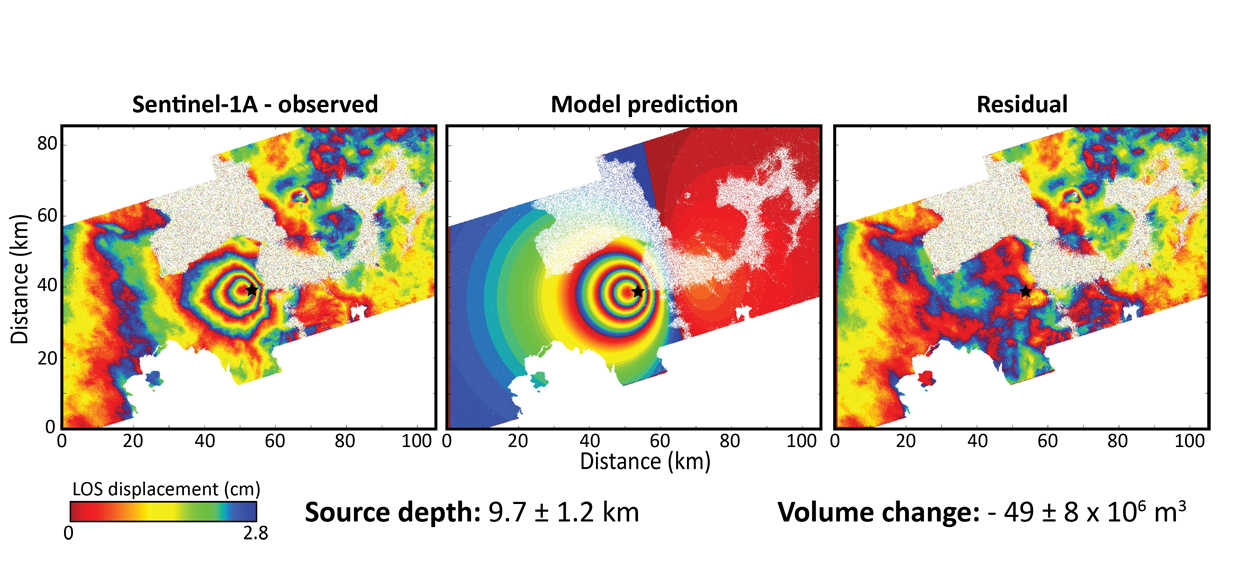
On 22nd April 2015 Calbuco volcano, Chile, erupted for the first time since 1972 with very little warning. Plumes of volcanic ash reached heights of 16 km on the 22nd and up to 17 km in a second, longer eruption that began in the early hours of 23rd April.

Several thousand people were evacuated from villages closest to Calbuco , and ash fell over an area extending from the west coast of Chile to the east coast of Argentina, and grounded air traffic in Chile, Uruguay and Argentina.

COMET scientists have been using satellite data to analyse the event, in terms of both the emissions and changes to the shape of the volcano itself.  You can read more about the event here.

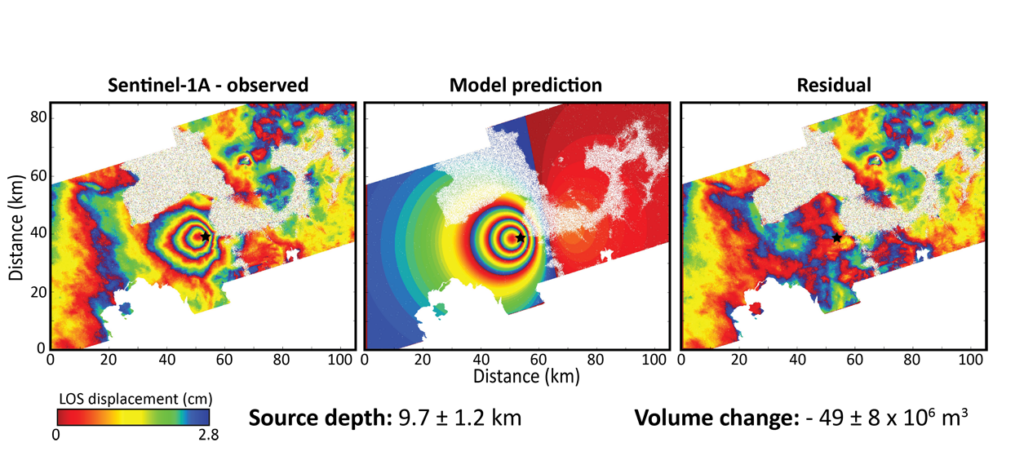
Data, spherical source elastic half space model and residuals for recent deformation at Calbuco [Bagnardi].

COMET Director, Tim Wright, receives Rosentiel Award

COMET Director Tim Wright has been selected as the 2015 Rosentiel Award Recipient by the University of Miami (UM) in recognition of his research into deformation of the Earth’s crust in response to tectonic forces.

The Rosenstiel Award honours scientists who, in the past decade, have made significant and growing impacts in their field.  Tim’s major achievements include the discovery of a continental rifting event in Ethiopia’s Afar region, one of the few places on Earth where a mid-ocean ridge comes ashore.

He was also one of the first scientists to measure how plate boundary zones deform, solely relying on satellite observations using a technique called satellite radar interferometry.

Tim presented the 2015 Rosenstiel Award Lecture, “Witnessing the Birth of Africa’s New Ocean” at the UM Rosenstiel School auditorium on Friday 3rd April 2015.

You can read more here.

Royal Astronomical Society discuss observing tectonics from space

On Friday 13th March 2015, the Royal Astronomical Society held a discussion meeting (supported by COMET) on advances in high-resolution topography and imagery.  

Christoph Gruetzner reports from the meeting here.

COMET on Radio 4’s “Costing the Earth”

Hear COMET’s Tamsin Mather and David Pyle on how we are monitoring volcanic risk on Radio 4’s programme Costing the Earth.

You can listen to the episode, “Lava: A Dangerous Game”, here.