Global Earthquake Model Foundation (GEM) 3-day workshop (28-30 September 2026)

Global Earthquake Model Foundation (GEM) 3-day workshop (28-30 September 2026)

We are delighted to announce that the Global Earthquake Model Foundation (GEM) is providing a 3-day workshop (28-30 September 2026) on Probabilistic Seismic Hazard Analysis (PSHA) at the Department of Earth Sciences, University of Oxford, OX1 3AN, UK. This workshop includes both an introduction to PSHA and discussion about specific topics at the frontiers of both earthquake science and PSHA practice. Participants will learn the basics of PSHA and the use of the OpenQuake tools for developing and running PSHA models, with a focus on fault-based seismic source model development. There will also be time for participants to present their research (on a volunteer basis) as well as ample time to discuss how to advance earthquake forecasting through deeper integration with earthquake science data and theory, in areas such as time dependence, on-fault vs. off-fault strain and seismicity.

This workshop is supported by the Natural Environment Research Council (NERC) through its funding of the UK’s subscription to the Global Earthquake Model Foundation.

Registration

  • Registration fee: Free.
  • To secure your place, please fill in the online registration form here. The registration form will stay open until 15/09/2026.

Precedence is given to students and academics in UK institutions.

Accommodation

Please note that accommodation is not included, so you’ll need to book your own. As Oxford is a popular tourist destination and late September is a busy time, we strongly recommend booking accommodation as early as possible. A few good places to start looking:

Transportation

Our department is conveniently located within walking distance of Oxford city centre, Oxford Train Station, and Gloucester Green Bus Station, making it easy to reach the workshop on foot from most city centre accommodation. If your accommodation is a little further away, we recommend using local bus services, taxis, or Uber. If you plan to drive to the workshop and require parking, please let us know in advance, as parking availability is limited.

Further practical information will be sent to registered participants closer to the workshop.

If you have any questions or require additional assistance, please contact [email protected] or [email protected]

Professor Juliet Biggs awarded a ten-year Faraday Discovery Fellowship

COMET Co-Director Professor Juliet Biggs (University of Bristol) was recently awarded a ten-year Faraday Discovery Fellowship from the Royal Society. The Royal Society states that the fellowship awards exceptional mid-career academics “using cutting-edge techniques to explore questions at the frontiers of human knowledge”, and recognise the achievements of the country’s leading researchers.

Juliet’s work is titled “MAGMA 4D – Improved resilience to volcanic hazards through satellite-based monitoring and forecasting”, and will focus on building a global satellite volcano observatory by combining next-generation satellite data, artificial intelligence, and physics-based models to improve the way volcanoes are monitored and forecast. With a greater understanding of how the volcanoes work, the research hopes to deliver earlier warnings and provide better projection for the communities at most risk.

Such long-term funding is rare and hugely important to be able to focus on these complicated real-world scenarios, create new and important global networks, and generate huge impact in the field.

We at COMET are thrilled with this success and look forward to seeing the amazing work and opportunities that will come with the project!

Join us for the next COMET webinar!

The UK Centre for Observation and Modelling of Earthquakes, Volcanoes and Tectonics (COMET) invites you to the next instalment of our COMET online webinar series.

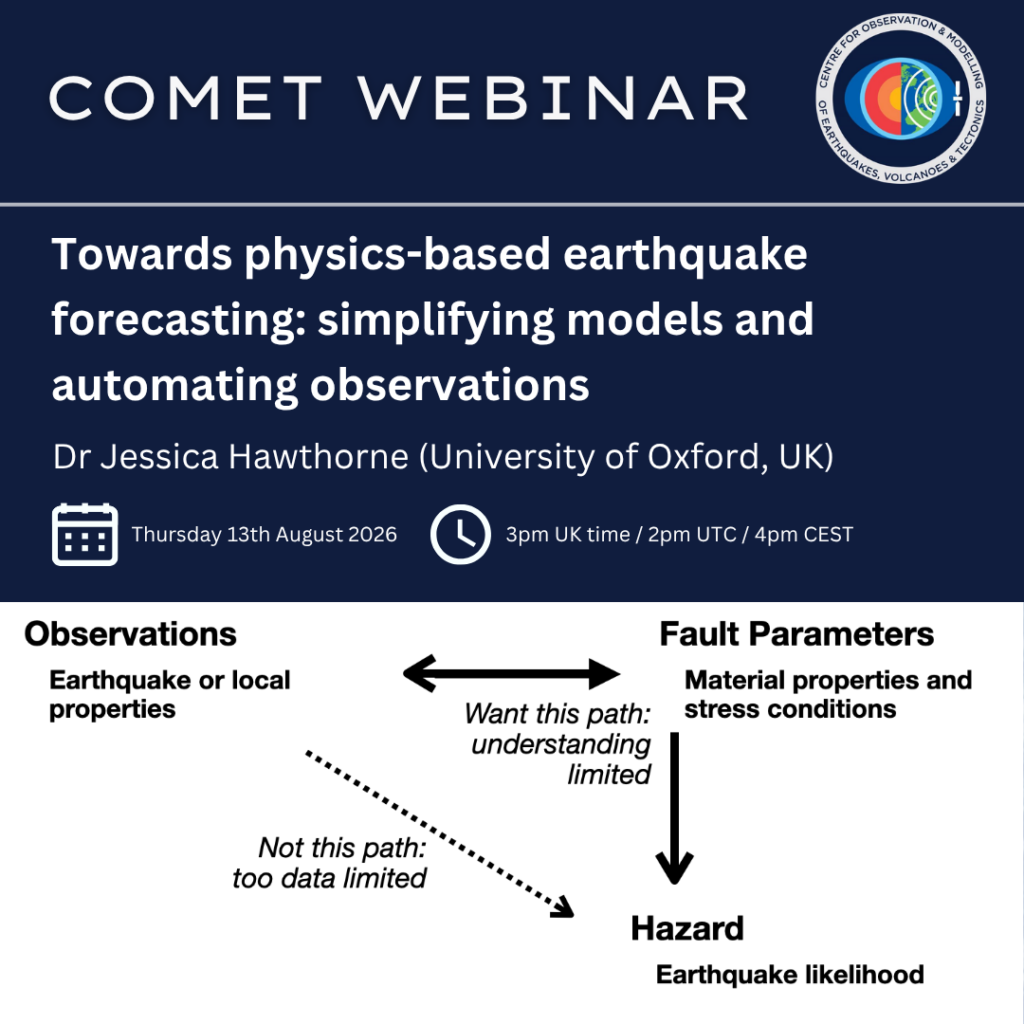
Speaker: Dr Jessica Hawthorne University of Oxford, UK

Title of the talk: Towards physics-based earthquake forecasting: simplifying models and automating observations

Date: Thursday 13th August 2026

Time: 3pm UK time (2pm UTC / 4pm CEST)

Register https://events.teams.microsoft.com/event/0692a3ec-6736-4420-bd95-ed7e7e809194@b311db95-32ad-438f-a101-7ba061712a4e

(After registering, you will receive a confirmation email containing information on how to join the webinar)

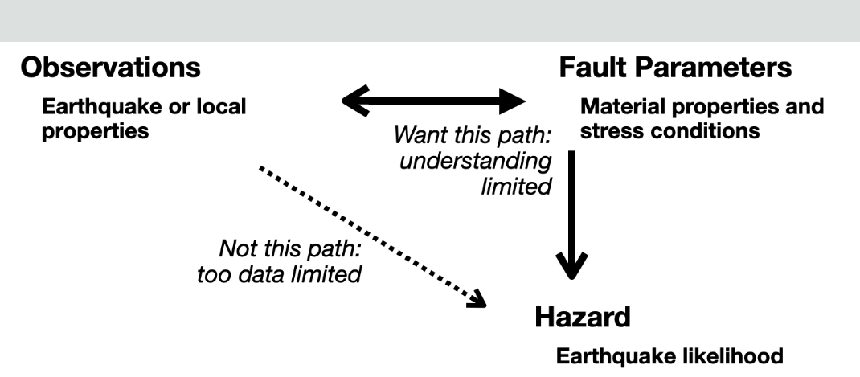
Abstract: Earthquake forecasts are commonly empirical, based primarily on the past distribution of earthquakes. But sometimes we want to forecast earthquakes in “new” scenarios, for instance during an aseismic slip event or induced seismicity. For these scenarios, we require more physics-based earthquake forecasts. In this presentation, we explore some of the observational, modelling, and practical challenges in developing physics-based earthquake forecasting. We focus on developing a simple modelling framework. The rupture simulations are based on energy balance: ruptures propagate as long as the stress intensity at the tip exceeds a critical threshold. Although this approach does not capture the full details of rupture propagation or more complex physics such as off-fault deformation, it does capture first-order rupture physics and allows many ruptures to be simulated in complex stress fields. To explore earthquake potential across a range of physical environments, we simulate ruptures in stress fields with different mean initial stresses, then perturb those fields. Ruptures nucleate from the point of maximum stress, and we track the frequency, magnitude, and stress drop of the resulting events. Restricting ruptures to one-dimensional geometries allows tens of thousands of simulations in a few hours on a desktop computer. These simulations define a mapping between fault initial conditions and resulting seismicity, which we represent with a neural network. We also explore another challenge in physics-based forecasting: making enough observations to constrain and test such models. We therefore also work on developing tools to observe more features of earthquakes, including their beginnings and their spatial extents. We show how these features can be systematically and quickly measured and how they may be used both to test physical models of earthquake rupture and to improve forecasting.