COMET scientist Dr John Elliott based at the University of Leeds is the latest winner of the John Wahr Early Career award from the AGU Geodesy section.
The John Wahr Early Career Award, formerly the Geodesy Section Award, is presented annually and recognizes significant advances in geodetic science, technology, applications, observations, or theory. The award is given to early or mid-career scientists who demonstrate the potential to be elected AGU Fellows in the future through outstanding contributions to geodesy.
The award will be presented to John at this year’s virtual AGU Fall Meeting in December 2020. Congratulations John from all of your COMET colleagues.
How satellite InSAR has grown from opportunistic science to routine monitoring over the last decade
COMET Deputy Director (Volcanoes), Prof. Juliet Biggs, and COMET Director, Prof. Tim Wright, have written a commentary on satellite InSAR for the 10 year anniversary of Nature Communications out in print! Read the article here.
An international group of research scientists including COMET researchers Prof. Tim Wright (COMET Director) and Prof. Andy Hooper, and led by Freysteinn Sigmundsson at the University of Iceland’s Institute of Earth Sciences, has presented a new method for evaluating when molten magma in volcano roots becomes unstable and forces its way towards the surface of the Earth. In an article published in the prestigious journal Nature Communications, the method is used to better understand precursors, onset and evolution of a large-volume eruption in Iceland in 2014-2015.
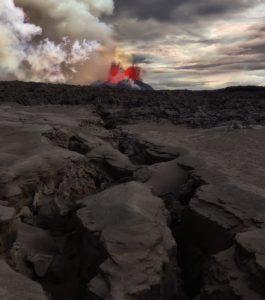
A large eruption. Photo credit: Jefferey Alan Karson, Syracuse University
Just over five years have passed since the end of the 2014-2015 Holuhraun eruption in the Bardarbunga volcanic system; an eruption that produced the largest lava field in Iceland for more than 200 years. The data gathered in the time leading up to the eruption and during it has proven a valuable source for new discoveries in earth sciences in recent years, and now for improved understanding of magma movements in volcano roots.
In the study published in Nature Communications the group of scientists shed light on what conditions need to be in place in a volcano for an eruption to start, and furthermore how eruptions develop and lead to caldera formation, i.e. when a large part of a volcano subsides at the same time as a large amount of magma reaches the surface, as was the case in the 2014-2015 activity.
“Previous methods to understand magma movements in the surface have certain limitations and are based on assumptions that are not always applicable. It is also noteworthy that some large-volume eruptions have small or minor precursors in terms of increased earthquake activity and magma movements. Small eruptions can on the other hand have large precursors. This is not what is expected from commonly used models that volcanologists have used to interpret monitoring data from volcanoes,” Freysteinn points out.
The research consisted of developing a new method to take jointly into consideration three important effects that influence how magma accumulates and then forces its way to the surface.
Firstly, magma may be less dense than the host rock surrounding it. Where magma accumulates in volcano roots it can therefore have a large upward directed buoyancy force. “This means that if sufficient magma accumulates, this force alone can break the surrounding host rock and magma can flow upwards,” explains Freysteinn.
Secondly, the host rock around magma bodies in volcano roots can behave as a ductile material. It can deform and flow in a ”viscoelastic manner” – such that solid rocks yields away from the magma and creates space for new magma without fracturing. This can happen if magma accumulates over long time, many years or still longer time periods.
“Finally, it must be considered that magma can form pipe-like pathways e.g. by eroding away part of surrounding rocks where magma flows. Such sustained magma channels do not easily close, even if pressure drops in underlying magma bodies that feed these magma channels. This means that following the peak of an eruption such a channel can thus remain open for considerable time,” adds Freysteinn.
By connecting these three factors together into one methodology a new approach to understand magma movements was created. The method was then applied to the Iceland unrest and large-scale eruption in 2014-2015 to demonstrate its applicability. “The series of events can be explained by the existence of magma below Bárðabunga for a long time prior to the eruption. The rock surrounding the magma yielded creating space for the magma. Evaluation of the magma and rock’s density shows that the magma could easily flow upwards. The magma was thus almost ready to burst forward, needing only a small inflow of additional magma to start the eruption. Thus a sustained magma channel was formed from the magma accumulation area resulting in a large drop in pressure leading to the caldera formation in Bárðarbunga,” explains Freysteinn.
The results are important as the method developed can be applied to all volcanoes. “The method points to certain features that scientists and those who monitor volcanoes need to consider when estimating if a new eruption will begin. Large eruptions can occur with only minor precursory activity,” concludes Freysteinn.
COMET has been awarded £950,000 by NERC to deliver cutting-edge research on earthquakes and volcanoes and to continue the development of hazard monitoring services.
NERC has officially announced the new funding for COMET on Wednesday 29 May. This will enable ambitious, large-scale science which helps us to understand global change and natural disasters over the next two years.
NERC National Capability lets the UK deliver world-leading environmental science, support national strategic needs, and respond to emergencies. It includes major research infrastructure and facilities, large-scale, long-term research programmes, and the provision of expert advice and services for public and national good.
You can read more about the award, and National Capability, on the NERC website.
Work led by COMET scientists Juliet Biggs and Andy Hooper is developing new methods for using artificial intelligence and satellite data monitor and potentially help predict volcanic eruptions.
Their work is described in a Nature article, published on 7 March 2019, which outlines how Juliet’s team at Bristol is using satellite imagery from the European Space Agency Sentinel-1 mission, alongside machine learning, to spot the formation of ground distortions around volcanoes.
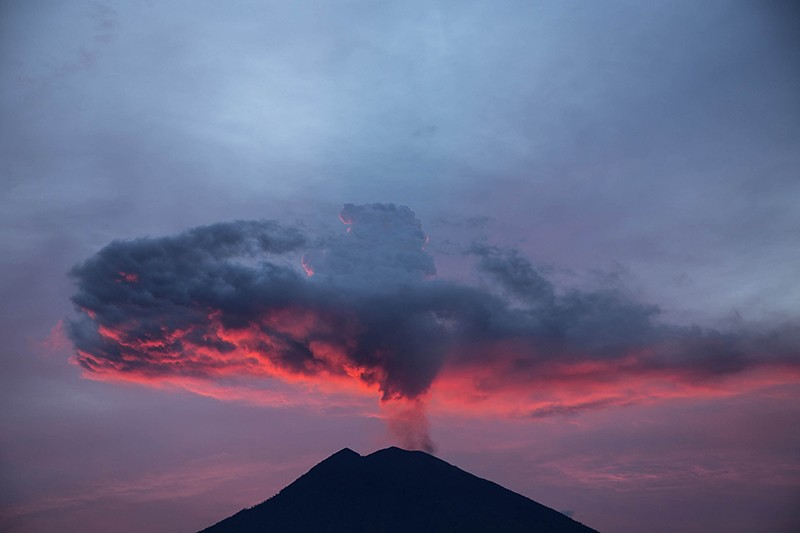
Agung volcano on the Indonesian island of Bali erupts in November 2017. Credit: Donal Husni/Zuma
Meanwhile at Leeds, Andy’s team is using a technique that searches for changes in the satellite data. Where the ground around a volcano is deforming, their method can flag if the distortion speeds up, slows down, or changes in some other way, allowing researchers to detect even small ground alterations.
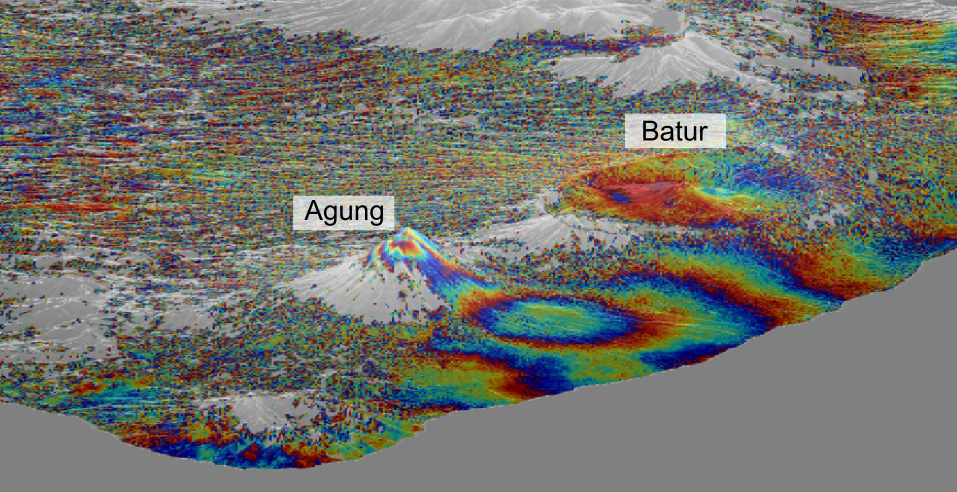
A team of scientists, led by the University of Bristol, has used satellite technology provided by the European Space Agency (ESA) to uncover why the Agung volcano in Bali erupted in November 2017 after 50 years of dormancy. Their findings, published in February 2019 in the journal Nature Communications, could have important implications for forecasting future eruptions in the area.
Two months prior to the eruption, there was a sudden increase in the number of small earthquakes occurring around the volcano, triggering the evacuation of 100,000 people. The previous eruption of Agung in 1963 killed nearly 2,000 people and was followed by a small eruption at its neighboring volcano, Batur. Because this past event was among the deadliest volcanic eruptions of the 20th Century, a great effort was deployed by the scientific community to monitor and understand the re-awakening of Agung.
During this time, a team of scientists from the University of Bristol’s School of Earth Sciences, led by Dr Juliet Biggs used Sentinel-1 satellite imagery provided by the ESA to monitor the ground deformation at Agung. Dr Biggs said: “From remote sensing, we are able to map out any ground motion, which may be an indicator that fresh magma is moving beneath the volcano.”
In the new study, carried out in collaboration with the Center for Volcanology and Geological Hazard Mitigation in Indonesia (CVGHM), the team detected uplift of about 8-10 cm on the northern flank of the volcano during the period of intense earthquake activity.
Dr Fabien Albino, also from Bristol’s School of Earth Sciences, added: “Surprisingly, we noticed that both the earthquake activity and the ground deformation signal were located five kilometres away from the summit, which means that magma must be moving sideways as well as vertically upwards”.
Our study provides the first geophysical evidence that Agung and Batur volcanoes may have a connected plumbing system. This has important implications for eruption forecasting and could explain the occurrence of simultaneous eruptions such as in 1963.
The study is funded by the Centre for Observation and Modelling of Earthquakes, Volcanoes and Tectonics (COMET), a world-leading research centre focusing on tectonic and volcanic processes using earth observation techniques.
The outstanding contributions of COMET UCL’s Professor Marek Ziebart to the science of space navigation, guidance and control have been recognised with a prestigious award from the US Institute of Navigation.
The Tycho Brahe Award is bestowed annually to an individual who has made a truly significant contribution to the science of spacecraft navigation and whose actions have benefited civilisation in any form.
Marek, who is Professor of Space Geodesy in the UCL Department of Civil, Environmental and Geomatic Engineering, focuses on the design of innovative navigation systems for spacecraft, including a navigation and communications system for manned and robotics missions to Mars and the moon between 2020 and 2040.
The US Institute of Navigation cited his outstanding innovation and leadership in the area of high precision, physics-based radiation force modelling for spacecraft orbit dynamics. His work has revolutionised the precision of satellite orbit modelling and led to a long running and successful collaboration with NASA Goddard Space Flight Center, where his methods have been applied to many NASA missions, including the Jason-1 satellite of the Ocean Surface Topography Mission to measure Earth’s sea levels.
Professor Ziebart said: “In receiving this award I’d like to acknowledge the help and support of my colleagues and the faculty at UCL. To me it seems that in this extraordinary institution you get smarter simply by osmosis. I feel privileged to be a part of UCL and working on research that is truly impactful and beneficial to the planet as a whole.”
The award was presented at a ceremony at the US Institute of Navigation in Washington on 31st January, 2019.
The achievements of four COMET scientists have been recognised in a recent spate of prizes!
Juliet Biggs, Reader at the University of Bristol, has been announced as a 2018 Philip Leverhulme Prize Winner, recognising her outstanding research in volcanology to date and future potential.
Juliet studies the physics by which plate boundaries develop by studying active volcanoes and earthquakes. Her work on Africa’s Great Rift Valley has demonstrated the relative role played by volcanoes, magma intrusions and faults during continental rifting.
Globally, she has discovered that many volcanoes previously believed to be dormant are actually restless, and investigated the link between deformation and eruption, and the mechanisms for coupled eruptions. Her work has changed the perception of geophysical hazards in Africa and the way in which volcanoes are monitored and modelled globally.
Juliet will use the prize to investigate the mechanisms that drive volcano deformation globally, by exploiting the new wealth of satellite data. This will include methods for combining satellite deformation and gas measurements to provide a new perspective on the role volatiles play in eruptions, and using deep learning tools to interrogate large datasets.
This award recognises her achievements in the field of volcanology as well as her ability to communicate with the public. Tamsin delivered the Rosalind Franklin Award Lecture on 18 October, speaking on how lessons learned sitting on the edge of an active volcano today can give us insights into some of the most profound environmental changes in geological history. With her award, Tamsin will now be implementing a project that raises the profile of women in STEM.
This is given every two years in recognition for “original contributions to the basic knowledge of crust and lithosphere.” Professor England will be awarded his medal at the AGU Fall Meeting later this year.
Finally, our congratulations go to the 2019 Thermo-Fisher Scientific VMSG awardee, Dr Marie Edmonds, Reader in Earth Sciences at the University of Cambridge.
This award is bestowed annually on an individual who has made a significant contribution to our current understanding of volcanic and magmatic processes, and Marie will give the VMSG keynote lecture in January 2019.
The timing and size of three deadly earthquakes that struck Italy in 2016 may have been pre-determined, according to new research published in Earth and Planetary Science Letters that could improve future earthquake forecasts.
A joint British-Italian team of geologists and seismologists have shown that the clustering of the three quakes might have been caused by the arrangement of a cross-cutting network of underground faults.
The findings show that although all three earthquakes occurred on the same major fault, several smaller faults prevented a single massive earthquake from occurring instead and also acted as pathways for naturally occurring fluids that triggered later earthquakes.
The cluster of three earthquakes, termed a “seismic sequence” by seismologists, each had magnitudes greater than six and killed more than 300 people in Italy’s Apennine mountains between 24 August and 30 October 2016.
Earthquake sequences
The research, led by COMET scientist Richard Walters from Durham University, comes on the second anniversary of the start of the earthquake sequence.
The researchers say the findings could have wider implications for the study of seismic hazards, enabling scientists to better understand potential earthquake sequences following a quake.
Dr Walters said: “These results address a long-standing mystery in earthquake science – why a major fault system sometimes fails in a single large earthquake that ruptures its entire length, versus failing in multiple smaller earthquakes drawn-out over months or years.
“Our results imply that even though we couldn’t have predicted when the earthquake sequence would start, once it got going, both the size and timing of the major earthquakes may have been pre-determined by the arrangement of faults at depth.
“This is all information we could hypothetically know before the event, and therefore, this could be a hugely important avenue for improving future earthquake forecasts.”
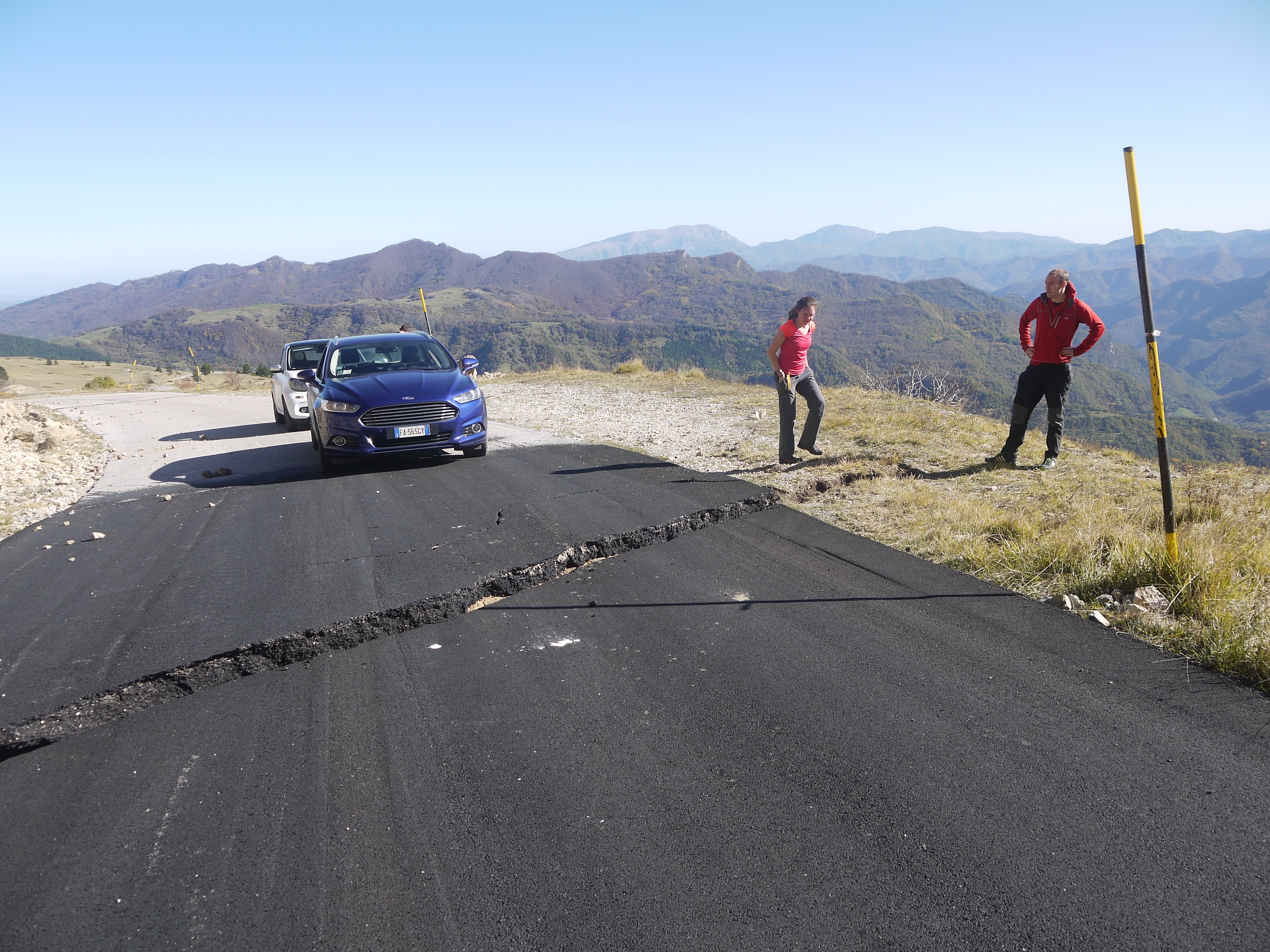
Location of survey site at rupture across a road near Castelluccio. The rupture occurred during the third earthquake in the seismic sequence and gives researchers a record of the deformation. Credit: L.Gregory
Thousands of aftershocks
Dr Walters and the team used satellite data to estimate which part of the fault failed in each earthquake, and compared this pattern with the location and timing of thousands of tiny aftershocks throughout the seismic sequence.
They found that intersections of small faults with the main fault system separated each of the three largest earthquakes, strongly suggesting these intersections stop the growth of each earthquake and prevent the faults failing in a single large event.
In addition, the scientists also found that after the first earthquake, thousands of aftershocks crept northwards along these same fault intersections at a rate of around 100 metres per day, in a manner consistent with naturally occurring water and gas being pumped along the faults by the first earthquake on 24 August, 2016.
The second earthquake, on the 26 October, occurred exactly when these fluids reached its location, therefore controlling the relative timing of failure.
Dr Walters added: “It was a big surprise that these relatively small faults were having such a huge influence over the whole sequence.
“They stop the first earthquake in its tracks, and then they channel the fluids that start the sequence up again months later. No-one’s ever seen this before.”
Seismic hazard
Co-author and COMET associate Dr Laura Gregory from the University of Leeds said it was important to understand whether or not a fault fails in a seismic sequence, and that the team’s results were only made possible by combining a varied array of different datasets.
Dr Gregory said: “A seismic sequence has vastly different implications for seismic hazard compared to a single large earthquake. If the faults in Italy in 2016 had failed together in one big event, the impact on the local population would have been much worse.
“This is the first time we’ve ever had this quality of modern data over one of these earthquake sequences, and bringing together a range of specialists was key for unpicking how the earthquakes related to one another.
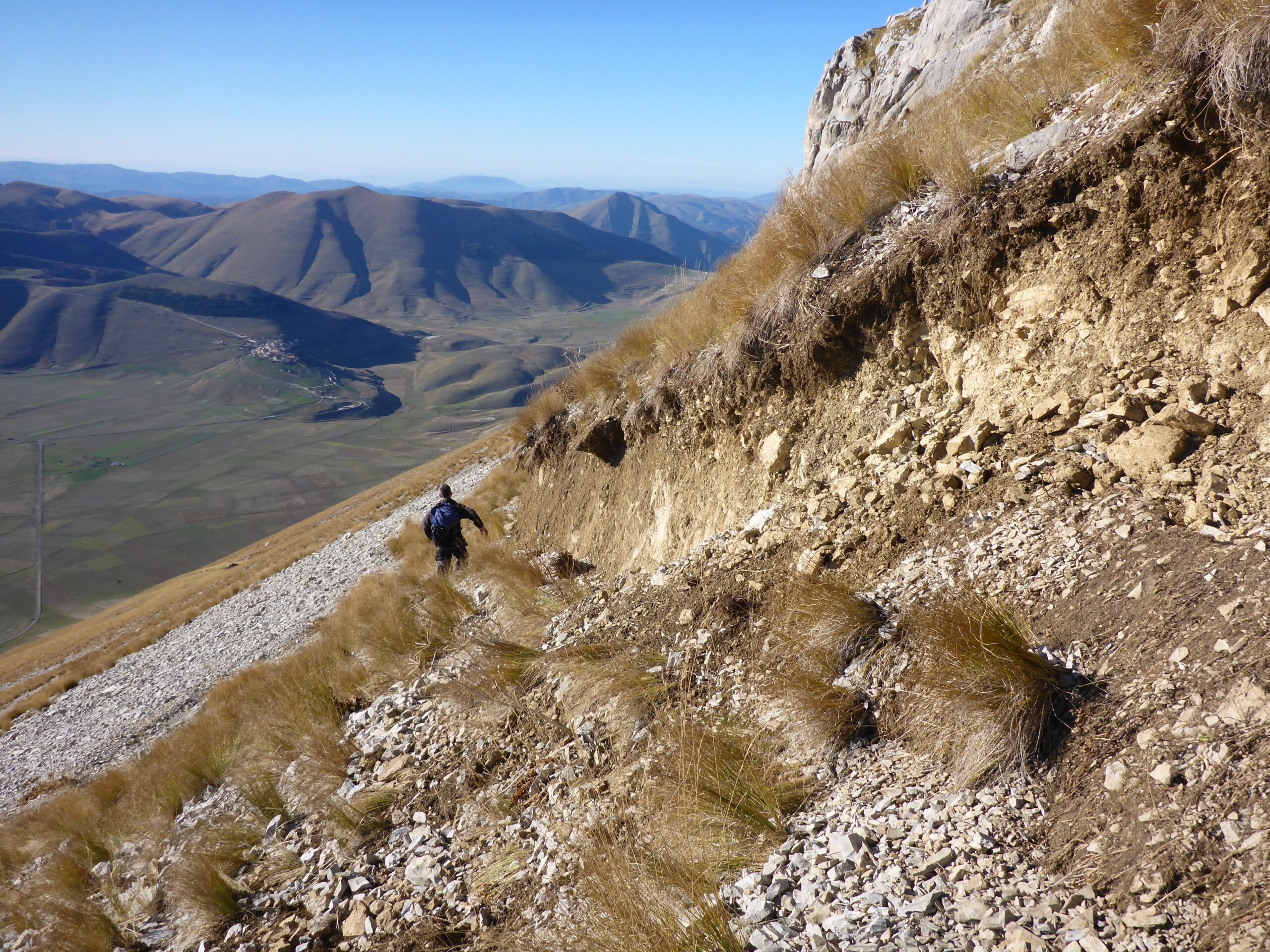
“I was scrambling over the mountainside immediately after each earthquake with British and Italian colleagues, measuring the metre-high cliffs that had suddenly formed. Meanwhile, other members of our team were analysing data from seismometers stationed around the world, or were mapping the tiny bending of the ground around the faults using satellites orbiting the planet at 500 miles altitude.”
The research was partly supported by both COMET and a NERC Urgency Grant.
The award is made to an individual for an outstanding contribution to any area of Science, Technology, Engineering and Mathematics (STEM) and to support the promotion of women in STEM.
Tamsin will receive a silver gilt medal at her Award Lecture in October 2018. Congratulations Tamsin from all of your COMET colleagues.
Manage Consent
To provide the best experiences, we use technologies like cookies to store and/or access device information. Consenting to these technologies will allow us to process data such as browsing behavior or unique IDs on this site. Not consenting or withdrawing consent, may adversely affect certain features and functions.
Functional
Always active
The technical storage or access is strictly necessary for the legitimate purpose of enabling the use of a specific service explicitly requested by the subscriber or user, or for the sole purpose of carrying out the transmission of a communication over an electronic communications network.
Preferences
The technical storage or access is necessary for the legitimate purpose of storing preferences that are not requested by the subscriber or user.
Statistics
The technical storage or access that is used exclusively for statistical purposes.The technical storage or access that is used exclusively for anonymous statistical purposes. Without a subpoena, voluntary compliance on the part of your Internet Service Provider, or additional records from a third party, information stored or retrieved for this purpose alone cannot usually be used to identify you.
Marketing
The technical storage or access is required to create user profiles to send advertising, or to track the user on a website or across several websites for similar marketing purposes.





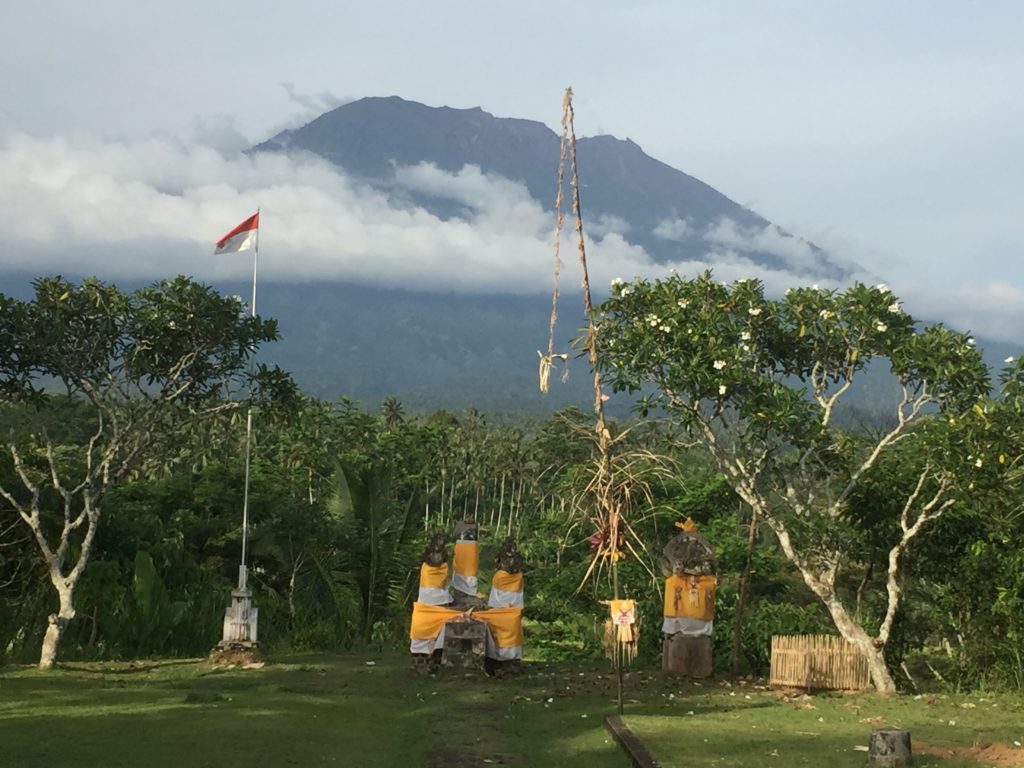 View of Mt. Agung on Nov. 10, 2017 from the Rendang Volcano Observatory, operated by CVGHM. Photo by Jake Lowenstern, USGS.